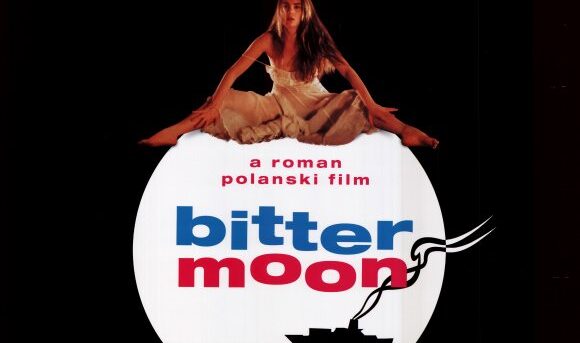
“Bitter Moon” (1992)
Drama / Thriller

Running Time: 139 minutes
Written by: Roman Polanski, Gérard Brach and John Brownjohn
Directed by: Roman Polanski
Featuring: Peter Coyote, Emmanuelle Seigner, Hugh Grant, Kristin Scott Thomas and Victor Banerjee
Oscar: “Have you ever truly idolized a woman? Nothing can be obscene in such love. Everything that occurs in between it becomes a sacrament.”
Roman Polanski’s Bitter Moon is a provocative exploration of passion, obsession, and the dark recesses of human relationships. Blending psychological drama, eroticism, and biting satire, the film delves into themes of love’s potential to both elevate and destroy. Anchored by gripping performances and a narrative that oscillates between beauty and cruelty, Bitter Moon is an unforgettable, if divisive, cinematic experience.
The story follows Nigel and Fiona Dobson (Hugh Grant and Kristin Scott Thomas), a buttoned-up British couple traveling aboard a luxury cruise ship. Their seemingly placid marriage becomes increasingly unsettled when they encounter the mysterious Mimi (Emmanuelle Seigner) and her paraplegic husband, Oscar (Peter Coyote).
Oscar, a failed writer, recounts the sordid details of his relationship with Mimi, from its initial fiery passion to its eventual descent into sadism, manipulation, and mutual destruction. As Nigel becomes enraptured by Oscar’s tales—and increasingly attracted to Mimi—the film pulls back layers of repression, revealing how easily love can transform into toxic obsession.
Polanski masterfully creates an atmosphere of unease, juxtaposing the glitzy, sterile setting of the cruise ship with the hedonistic, chaotic flashbacks of Oscar and Mimi’s relationship. Thematically, Bitter Moon examines the boundaries of love and desire, pushing characters (and audiences) to confront uncomfortable truths about their own fantasies and insecurities.
At its heart, the film explores power dynamics in relationships, particularly how intimacy can be wielded as a weapon. Oscar and Mimi’s romance initially seems intoxicatingly free-spirited, but it soon reveals itself as a dance of dominance and submission. Their unraveling contrasts sharply with the repressed, stagnant connection between Nigel and Fiona, creating a commentary on the varying ways relationships can become prisons—whether through excess or neglect.
Peter Coyote delivers a magnetic performance as Oscar, seamlessly transitioning between sardonic humor, bitterness, and vulnerability. His narration is as seductive as it is repulsive, drawing Nigel (and viewers) into the sordid web of his past. Emmanuelle Seigner’s Mimi is a force of nature—seductive, enigmatic, and ultimately tragic. Her chemistry with Coyote is palpable, making their toxic relationship simultaneously horrifying and mesmerizing.
Hugh Grant and Kristin Scott Thomas are equally compelling in more restrained roles. Grant, in particular, brings a subtle transformation to Nigel, whose initial moral superiority gradually gives way to voyeuristic fascination. Thomas, though given less screen time, imbues Fiona with a quiet dignity that underscores the film’s exploration of repression and betrayal.
Polanski’s direction is meticulous, with every frame serving the film’s layered storytelling. The cruise ship becomes a microcosm of societal facades, while the flashbacks—set in Paris—are drenched in sensuality and decadence. Cinematographer Tonino Delli Colli captures the duality of the narrative beautifully, alternating between the sterile elegance of the present and the lush, chaotic vibrancy of the past.
The film’s pacing is deliberate, reflecting the way Oscar doles out his story in tantalizing pieces. This structure keeps the audience, much like Nigel, on edge—both eager and afraid to learn what happens next.
Bitter Moon is not without its flaws. The film’s overt eroticism and unflinching portrayal of cruelty may alienate some viewers, and its tonal shifts—from dark comedy to melodrama—can feel jarring. Additionally, the characters’ actions and motivations occasionally stretch believability, particularly Nigel’s passive acceptance of Oscar’s shocking revelations.
However, these elements also contribute to the film’s audacious charm. Polanski’s willingness to embrace excess and moral ambiguity makes Bitter Moon a deeply provocative piece of cinema that defies easy categorization.
Bitter Moon is a dark, daring film that lingers long after the credits roll. Its exploration of love’s darker side is both uncomfortable and compelling, bolstered by outstanding performances and Polanski’s confident direction. While its provocative content ensures it won’t appeal to everyone, those willing to engage with its raw and uncompromising vision will find a richly layered, thought-provoking work.
This is a film that dares to ask: how far are we willing to go in the name of love, and at what cost? For better or worse, Bitter Moon offers no easy answers—only a mirror reflecting humanity’s deepest desires and fears.
This ambiguity is one of Bitter Moon’s greatest strengths. Rather than providing moral clarity, the film forces viewers to wrestle with the uncomfortable truths it lays bare. The cyclical nature of Oscar and Mimi’s relationship, where love and hate become indistinguishable, serves as a cautionary tale about the perils of unchecked passion. Yet, Polanski resists the temptation to fully condemn their behavior, leaving room for empathy amidst the chaos.
The ending of the film, which shifts the focus back to Nigel and Fiona, is particularly striking. As Nigel becomes entangled in Oscar and Mimi’s world, his own seemingly stable marriage begins to unravel. Polanski uses this parallel to suggest that repression and prudishness can be just as destructive as indulgence and excess. The final moments are haunting, suggesting that once one is exposed to the extremes of human emotion, it’s impossible to return to a state of ignorance.
When viewed through the lens of Polanski’s filmography, Bitter Moon feels like a natural extension of his recurring themes. The director has long been fascinated by the darker aspects of human nature, exploring them in works like Repulsion (1965) and The Tenant (1976). Bitter Moon stands out for its overt sensuality and its blackly comedic tone, offering a more playful yet equally unsettling examination of the human psyche.
The film’s release in 1992 positioned it as a stark contrast to more mainstream depictions of romance during the period. While Hollywood was churning out polished love stories and romantic comedies, Polanski offered an uncompromising look at love’s potential for toxicity. This boldness, while polarizing, earned Bitter Moon a cult following over the years, with many praising its unflinching honesty.
Bitter Moon remains a polarizing film to this day, with critics and audiences divided over its merits. For some, it’s a masterpiece of erotic drama and psychological insight; for others, it’s an overly cynical and melodramatic take on relationships. However, its ability to provoke strong reactions is a testament to its enduring power.
Decades after its release, the film continues to resonate, particularly in the #MeToo era, as audiences reevaluate the dynamics of power and consent in relationships. While some aspects of Bitter Moon may feel dated or overly exaggerated, its core message about the fragility and complexity of human connection remains timeless.
For viewers willing to confront its darker themes, Bitter Moon offers a raw, unvarnished look at love’s most destructive tendencies. It’s a film that challenges, provokes, and seduces in equal measure, leaving a lasting impression that’s impossible to shake. Polanski’s bold direction, combined with unforgettable performances by Peter Coyote and Emmanuelle Seigner, makes this a must-watch for fans of daring, uncompromising cinema. While it may not be a comfortable watch, Bitter Moon is a film that dares to bare its soul—and demands that its audience do the same.


 spryfilm.com