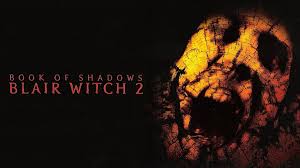
“Book of Shadows: Blair Witch 2” (2000)
Horror

Running Time: 90 minutes
Written by: Dick Beebe and Joe Berlinger
Directed by: Joe Berlinger
Featuring: Kim Director, Jeffrey Donovan, Erica Leerhsen, Tristine Skyler and Stephen Barker Turner
Sheriff Cravens: “Wipe that shit off your face! You think that your makeup and black clothes give you POWER… but you’re just a scared, cowardly, little girl underneath all that.”
When The Blair Witch Project hit theaters in 1999, it revolutionized the horror genre, popularizing the found-footage format and delivering a raw, minimalist experience that blurred the line between fiction and reality. In stark contrast, its sequel, Book of Shadows: Blair Witch 2, released just a year later, took a sharp turn into a more conventional narrative structure. Directed by Joe Berlinger, a filmmaker renowned for his work in documentaries, the sequel aimed to deconstruct the hysteria surrounding the first film. Unfortunately, Book of Shadows became a polarizing piece of cinema, criticized for its tonal inconsistencies, lack of scares, and departure from its predecessor’s groundbreaking approach.
Book of Shadows opens with an intriguing meta-layer: the events of The Blair Witch Project are treated as fictional within this film’s universe, and the story focuses on a group of fans drawn to Burkittsville, Maryland, to explore the legend. Jeff (Jeffrey Donovan), a local tour guide with a dark past, leads the group, including a Goth psychic (Kim Director), a Wiccan (Erica Leerhsen), and a skeptical academic couple (Tristen Skyler and Stephen Barker Turner). After a night in the woods, the group awakens to find evidence of inexplicable occurrences. Paranoia sets in as they try to piece together what happened, leading to disturbing revelations and tragic consequences.
Strengths
Meta Commentary: The film’s most compelling aspect is its attempt to critique the media frenzy surrounding the original Blair Witch. By incorporating themes of mass hysteria, groupthink, and the power of belief, it tries to transcend simple scares and delve into psychological territory.
Atmosphere: The film captures a genuinely eerie tone, especially in its woodland sequences. The use of quick-cut visuals, unsettling flashbacks, and grainy security footage adds a layer of discomfort.
Soundtrack: Featuring artists like Marilyn Manson and Queens of the Stone Age, the soundtrack is a time capsule of early 2000s alt-rock and industrial music, setting a dark, angsty mood.
Weaknesses
Lack of Cohesion: Book of Shadows struggles to decide what it wants to be. It oscillates between a psychological thriller, a meta-commentary, and a supernatural horror film, often failing to deliver on any front. This lack of focus makes the story feel disjointed and unfulfilling.
Characterization: The characters are one-dimensional and often unlikable, making it difficult for audiences to connect with their plight. Their decisions often feel illogical, detracting from the tension the film tries to build.
Studio Interference: Berlinger’s original vision for a slow-burning psychological drama was re-edited by the studio, which added jump scares, gore, and a nonlinear structure to cater to mainstream audiences. This tampering resulted in a film that feels tonally inconsistent and unfinished.
Visuals: Despite some effective moments, much of the visual storytelling feels overly stylized and artificial compared to the raw, visceral simplicity of the original. The glossy cinematography clashes with the grounded, documentary-like aesthetic that defined The Blair Witch Project.
At the time of its release, Book of Shadows was a critical and commercial disappointment. It was lambasted for abandoning the found-footage format, lacking genuine scares, and being derivative of other psychological horror films of the era. Over time, however, it has garnered a cult following. Some viewers appreciate its ambition and thematic depth, even if its execution leaves much to be desired.
For those willing to approach it as a standalone film rather than a direct sequel, there are intriguing ideas to be found. It’s a bold, if flawed, attempt to do something different rather than simply rehashing the original.
As a sequel, Book of Shadows: Blair Witch 2 faced the daunting challenge of living up to its predecessor’s cultural impact. Its failure to meet expectations has cemented its place in the annals of disappointing follow-ups. Yet, the film’s daring approach and thematic aspirations invite reconsideration.
Berlinger’s decision to explore the cultural aftermath of The Blair Witch Project was bold. By addressing the lines between reality, fiction, and perception, the film posed intriguing questions: How do media and mass hysteria shape belief systems? How does collective paranoia breed violence and confusion? These ideas resonate, especially in a modern context where “fake news” and viral phenomena dominate public discourse.
However, the film fails to weave these themes seamlessly into its narrative. The critique of sensationalism often feels like an afterthought, overshadowed by conventional horror tropes. It’s a classic case of ambition exceeding execution, with the film struggling to find a balance between intellectual exploration and visceral entertainment.
Joe Berlinger, known for documentaries like Paradise Lost, initially envisioned Book of Shadows as a grounded psychological thriller that would reflect on how people internalized and exploited the Blair Witch mythology. His approach leaned heavily on ambiguity and psychological tension rather than overt scares or supernatural elements.
Unfortunately, Berlinger’s vision was compromised by studio interference. Test screenings led to reshoots that inserted gratuitous gore, quick-cut horror sequences, and a fragmented narrative structure. The studio’s desire to replicate the visceral intensity of the first film undermined the deliberate pacing and ambiguity that Berlinger had aimed for. As a result, the final product is a jumbled hybrid that alienated fans of the original while failing to attract a new audience.
In the years since its release, Book of Shadows has found a niche audience that appreciates its ambition and willingness to subvert expectations. Its exploration of belief systems and the human psyche has earned it a degree of scholarly attention, with some viewing it as an underrated gem trapped in the wrong marketing strategy.
Modern audiences, who approach the film without the burden of 1999’s Blair Witch hype, may find it more palatable. In an era dominated by nostalgia-driven reboots and sequels, Book of Shadows stands out as a sequel that dared to chart its own course—albeit clumsily.
Book of Shadows: Blair Witch 2 is a fascinating misfire. While it deserves credit for its ambition and willingness to take risks, its muddled execution and identity crisis prevent it from standing on its own merits. Fans of experimental horror or meta-narratives might find it worth revisiting, but for most, it remains a cautionary tale of how not to follow up a cultural phenomenon.
Special Features & Technical Specs:
- 1080p high-definition presentation on Blu-ray
- Audio Commentary by director Joe Berlinger
- Audio Commentary on select scenes by composer Carter Burwell
- NEW Created by Hysteria: Directing Book of Shadows – Interview with co-writer / director Joe Berlinger (2024)
- NEW We Brought Something Back: Filming Book of Shadows – interview with director of photography Nancy Schreiber (2024)
- The Secret of Esrever – archival featurette
- Shadow of The Blair Witch – documentary (2000)
- Burkittsville 7 – documentary (2000)
- Soundtrack Trailer and Live Performance by Godhead
- Archival interviews with cast and crew
- Cast interviews from the set
- Theatrical Trailer
- Teaser Trailer
- Audio English 5.1 Surround + LPCM 2.0 Stereo
- Original Aspect Ratio 1.78:1
- Optional English HOH Subtitles


 spryfilm.com