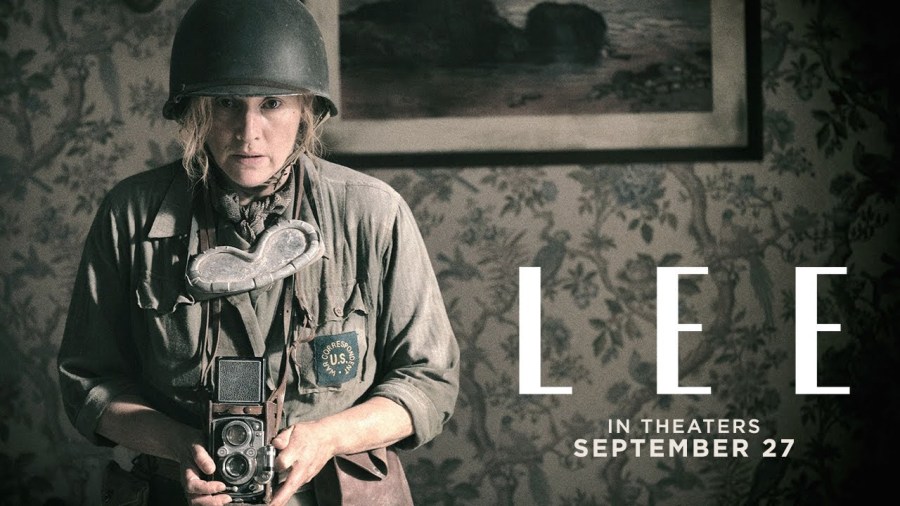
“Lee” (2024)
Drama

Running Time: 116 minutes
Written by: Liz Hannah, John Collee, and Marion Hume
Directed by: Ellen Kuras
Featuring: Kate Winslet, Marion Cotillard, Andrea Riseborough, Andy Samberg, Noémie Merlant, Josh O’Connor and Alexander Skarsgård
Lee Miller: “I’m going to the front. Are you coming?”
David E. Scherman: “That’s not what I was expecting you to say.”
Ellen Kuras’s Lee is a cinematic exploration of the extraordinary life of Lee Miller, a pioneering war correspondent and surrealist photographer. With a powerful performance by Kate Winslet, the film delves into the complexities of Miller’s journey, from her early days as a model to her harrowing experiences on the frontlines of World War II.
The film begins by introducing us to Miller as a young woman navigating the world of fashion and art. Her relationship with Man Ray, a renowned Surrealist artist, serves as a catalyst for her artistic development. However, Miller’s ambitions extend beyond the studio, and she soon finds herself drawn to the chaos and brutality of war.
As a war correspondent, Miller’s courage and determination are undeniable. She embeds herself with Allied forces, capturing the horrors of conflict with a raw and unflinching lens. Her photographs provide a stark and disturbing glimpse into the realities of war, challenging the traditional portrayal of women as passive victims.
Lee is not afraid to confront the darker aspects of Miller’s life. The film explores her complex relationship with her father, the impact of her wartime experiences on her mental health, and the challenges she faced as a woman in a male-dominated field. Winslet’s performance is both nuanced and powerful, capturing Miller’s inner turmoil and resilience.
The cinematography is visually striking, with Kuras’s use of light and shadow creating a haunting atmosphere. The film’s pacing is deliberate, allowing the audience to fully immerse themselves in Miller’s world. However, some viewers may find the narrative structure to be somewhat fragmented, jumping between different time periods and locations.
Lee does an excellent job of exploring Miller’s connection to the Surrealist art movement. Her work with Man Ray, as well as her own independent projects, reveal her fascination with the subconscious, dreams, and the exploration of the absurd. The film subtly weaves these elements into Miller’s narrative, suggesting that her experiences as a war correspondent were, in some ways, a continuation of her Surrealist exploration.
One of the most compelling aspects of Lee is its exploration of the long-lasting impact of trauma. Miller’s experiences on the frontlines were undoubtedly harrowing, and the film does not shy away from depicting the psychological toll they took on her. Winslet’s performance is particularly powerful in conveying Miller’s internal struggles and her attempts to cope with the horrors she witnessed.
Lee is a timely reminder of the contributions of women to history. Miller’s courage and determination in the face of adversity make her a feminist icon. The film challenges traditional gender roles and stereotypes, presenting Miller as a complex and multifaceted individual who defied expectations.
While Lee is a remarkable film, it is not without its flaws. Some viewers may find the narrative structure to be somewhat disjointed, and the film’s pacing may be slow at times. Additionally, some critics have argued that the film could have benefited from a more in-depth exploration of Miller’s personal life and relationships.
Lee is a bold and uncompromising film that offers a fresh perspective on the life of a remarkable woman. While it may not be for everyone, those who appreciate historical dramas and thought-provoking storytelling will find much to admire in this powerful and moving work.



 spryfilm.com