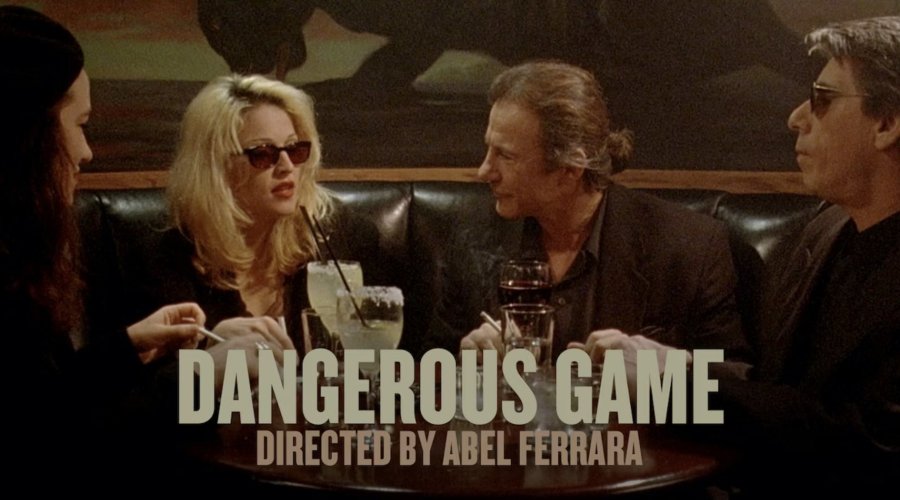
“Dangerous Game” (1993)
Drama

Running time: 109 minutes
Written by: Nicholas St. John
Featuring: Harvey Keitel, Madonna and James Russo
Sarah Jennings: “What is a brunette standing between two blondes? An interpreter.”
Dangerous Game (1993), directed by Abel Ferrara, is a provocative and deeply unsettling drama that blurs the lines between fiction and reality. Starring Harvey Keitel, Madonna, and James Russo, the film is a raw exploration of art, morality, and personal destruction, challenging audiences with its abrasive style and uncomfortable subject matter. Known for his gritty and often controversial films, Ferrara once again delves into the dark side of human nature, but this time, within the claustrophobic and volatile world of filmmaking itself.
The story revolves around Eddie Israel (Harvey Keitel), a director making an intensely personal film about a disintegrating marriage, featuring actors Sarah Jennings (Madonna) and Frank Burns (James Russo). As the film progresses, the boundaries between the characters’ real lives and their roles begin to blur, leading to increasingly volatile and destructive behavior both on and off the set. Eddie, as the director, manipulates his actors to extract raw, emotional performances, but in doing so, he opens a Pandora’s box of violence, cruelty, and personal demons. The film within the film, titled Mother of Mirrors, serves as a mirror itself, reflecting the inner turmoil and existential crises of its characters.
Dangerous Game is a film about control, manipulation, and the high cost of artistic expression. Ferrara explores the ethical implications of how far an artist should go in pursuit of truth, asking whether the end justifies the means. Eddie, in his obsessive quest to capture the rawest emotions, becomes a tyrant, pushing his actors to their psychological and emotional limits. In this sense, the film reflects on the darker aspects of the filmmaking process, where the director, like a puppeteer, pulls the strings to create art, even at the expense of human well-being.
At its core, Dangerous Game examines the destructive potential of mixing professional and personal lives. As the actors’ on-screen relationship deteriorates, so too does their off-screen dynamic. The violence and emotional abuse that unfolds in the fictional narrative spills into reality, suggesting that there is a dangerous line between art and life that, once crossed, can lead to irreparable damage.
Ferrara also delves into themes of guilt, redemption, and self-destruction. Eddie’s character, like many of Ferrara’s protagonists, is deeply flawed, caught in a cycle of moral conflict and self-loathing. His manipulative tactics are justified under the guise of artistic integrity, but as the film progresses, it becomes clear that he, too, is unraveling, lost in his own moral quagmire.
Harvey Keitel delivers a searing performance as Eddie Israel. Keitel, a frequent collaborator with Ferrara, is perfect in the role of the tormented director. His portrayal of Eddie is one of a man driven by his own inner demons, unable to separate his personal life from his work. Keitel’s intensity carries the film, with moments of vulnerability and anger that give the character depth and complexity. Eddie’s descent into moral ambiguity and madness is both disturbing and mesmerizing.
Madonna, in one of her most controversial roles, gives a performance that is raw and unfiltered. As Sarah Jennings, she is forced to navigate a character who is emotionally exploited by the men around her, both in the film’s fictional narrative and in reality. While Madonna’s acting has been criticized in the past, in Dangerous Game she brings an authenticity and vulnerability that is often uncomfortable to watch. Her willingness to engage with the film’s darker themes of abuse and manipulation shows her commitment to the role, even if her performance occasionally lacks the subtlety that the material demands.
James Russo, as Frank Burns, is equally compelling, portraying a character who is unhinged and emotionally unstable. His volatile relationship with Sarah is central to the film’s narrative, and Russo brings a raw intensity that matches the film’s chaotic energy.
Abel Ferrara’s direction in Dangerous Game is both confrontational and voyeuristic. He crafts the film in a way that feels unpolished and raw, mirroring the emotional chaos of its characters. The handheld camera work and often jarring editing contribute to the sense of unease, making the viewer feel like they are intruding on something deeply personal and uncomfortable. Ferrara’s decision to break the fourth wall at times, showing the actors out of character and the filmmaking process itself, adds to the meta-narrative of blurring fiction and reality. This technique reinforces the film’s central question: Where does art end and life begin?
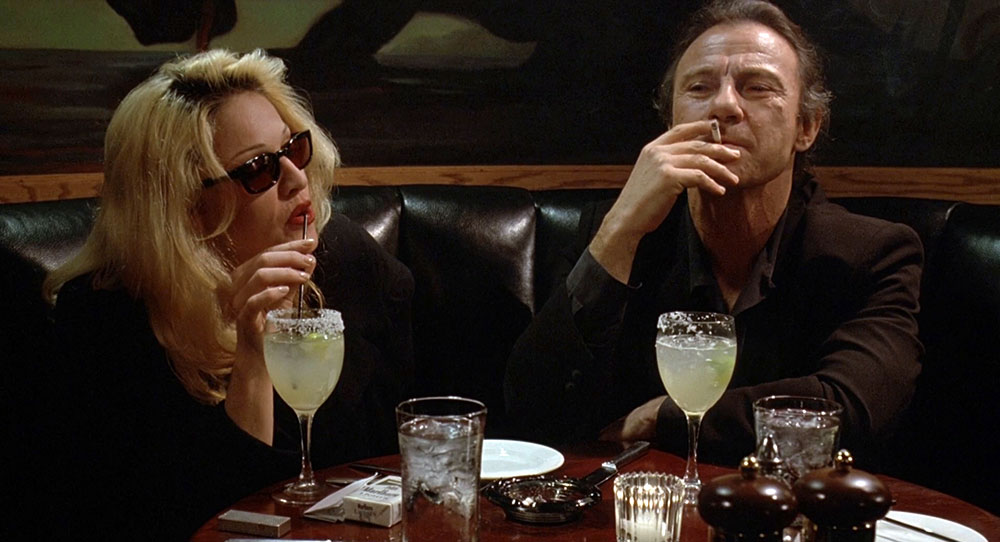
Cinematographer Ken Kelsch employs a gritty, almost documentary-like style, with harsh lighting and tight, claustrophobic framing that heighten the film’s intensity. The visual style enhances the feeling of emotional confinement, reflecting the characters’ entrapment in their own lives and roles. The juxtaposition of raw, unfiltered scenes with more polished moments of the film-within-the-film adds to the disorienting experience of watching Dangerous Game.
Upon its release, Dangerous Game was met with mixed reviews, with some critics lauding Ferrara’s bold vision while others found the film too self-indulgent and chaotic. The film’s graphic depiction of emotional and physical violence, particularly towards Madonna’s character, sparked controversy. Madonna’s participation in such a bleak and explicit film was a departure from her previous roles, and while some appreciated her commitment to the material, others criticized her performance as overwrought.
The film’s meta-narrative, while intellectually stimulating, alienated some audiences who found it difficult to engage with the characters on an emotional level. The lack of a clear boundary between fiction and reality can be disorienting, and Ferrara’s unapologetic approach to exploring dark and uncomfortable themes made Dangerous Game a polarizing film.
Dangerous Game is not an easy film to watch. It is abrasive, challenging, and at times, deeply disturbing. But it is also a film that asks important questions about the cost of artistic expression and the ethical responsibilities of those who create. Ferrara’s unflinching exploration of emotional and psychological violence makes for a harrowing viewing experience, but one that lingers long after the credits roll.
For those familiar with Ferrara’s work, Dangerous Game fits squarely within his oeuvre of films that confront the darker aspects of human nature. However, it is not a film for everyone. Its confrontational style, meta-narrative, and often unlikable characters can be alienating. But for those willing to engage with its complex themes and raw performances, Dangerous Game offers a powerful and thought-provoking exploration of art, morality, and the human condition.
Dangerous Game is a bold and uncompromising film that forces its audience to confront uncomfortable truths about the nature of art and the people who create it. It is a film that, like the characters it portrays, exists on the edge, constantly blurring the line between reality and fiction, leaving us to question where one ends and the other begins.
Special Features and Technical Specs:
- 1080p High-definition presentation on Blu-ray
- NEW Broken Hearts Down Broadway: Rewriting the Rules – interview with director Abel Ferrara (2024)
- NEW Primal Therapy – interview with actor James Russo (2024)
- NEW Something Real: Cutting ‘Dangerous Game‘ – interview with editor Anthony Redman (2024)
- NEW A Dangerous Design – interview with production designer Alex Tavoularis (2024)
- NEW Let’s Try: Upping Her Team’s ‘Dangerous Game’ – interview with producer Diana Phillips (2024)
- Theatrical Trailer
- Audio English LPCM 2.0 Stereo
- Original Aspect Ratio 1.85:1
- Optional English HOH Subtitles





 spryfilm.com