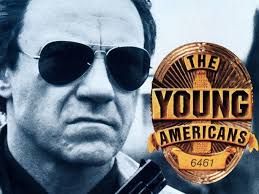
“The Young Americans” (1992)
Drama

Running time: 103 minutes
Written by: Danny Cannon and David Hilton
Featuring: Harvey Keitel, Iain Glen, John Wood, Terence Rigby, Keith Allen, Craig Kelly, Thandie Newton and Viggo Mortensen
“London Is Not Only Losing Her Soul To The Americans, She’s Selling It.”
“Young Americans” (1993) is a British crime drama film directed by Danny Cannon, and it stars Harvey Keitel, Iain Glen, and Thandiwe Newton. It is often remembered for its dark and gritty depiction of London’s criminal underworld and an impressive performance by Harvey Keitel, who plays an American cop brought in to assist with a string of violent crimes.
The story follows Detective John Harris (Harvey Keitel), an experienced New York cop, who is called to London to help investigate a series of brutal gangland killings involving young, reckless members of a dangerous American gang. These crimes are orchestrated by a charismatic yet ruthless gang leader, Carl Frazer (Viggo Mortensen), who is attempting to expand his criminal empire from the United States into London. As Harris teams up with Scotland Yard detective Edward Foster (Iain Glen), he finds himself immersed in a world of violence, betrayal, and a clash of cultures. As the investigation unfolds, Harris and Foster must navigate through the complexities of London’s criminal world, filled with deceit, corruption, and personal vendettas.
Harvey Keitel delivers a strong performance as Detective John Harris, bringing a sense of gravitas and world-weariness to his role. His portrayal of an American detective navigating the unfamiliar British system and customs adds a layer of fish-out-of-water humor, which contrasts with the darker tones of the story. Iain Glen, as the local detective Foster, provides a solid performance, effectively portraying a character caught between his professional duties and his personal struggles. The dynamic between Harris and Foster, though not groundbreaking, is compelling enough to keep viewers engaged.
Viggo Mortensen’s performance as Carl Frazer is one of the film’s highlights. He manages to bring a menacing charm to the character, making Frazer a memorable and formidable villain. Mortensen’s portrayal is both chilling and charismatic, adding depth to a role that could have easily fallen into cliché territory.
Thandiwe Newton, in one of her early roles, plays Rachael Stevens, a young woman caught in the crossfire of the gang’s violent world. Although her screen time is limited, Newton’s presence adds an emotional core to the story, providing a human element amidst the chaos and violence.
Danny Cannon’s direction gives “Young Americans” a distinctly dark and atmospheric feel, capturing the grimy, rain-soaked streets of London in a way that enhances the film’s noirish qualities. The film’s cinematography by Vernon Layton plays a significant role in setting the tone, with moody lighting and sharp contrasts that accentuate the tension and sense of danger. The action sequences are competently handled, and Cannon’s background in TV crime dramas is evident in the way the plot unfolds, though at times, it leans heavily on familiar tropes of the genre.
“Young Americans” explores themes of cultural clash, loyalty, and the seductive allure of power and violence. The film delves into the complexities of American versus British policing styles and highlights the generational divide between the older, more experienced Harris and the younger, more impulsive British officers. Additionally, the film touches on the impact of American pop culture and criminal enterprises on British society, presenting a critique of the influence of American gang culture abroad.
The portrayal of gang life and the allure it holds for young people is depicted with a gritty realism, though the film doesn’t delve too deeply into the social or economic factors driving these characters. Instead, it focuses more on the surface-level appeal of the gang lifestyle, with its fast cars, guns, and sense of belonging. This approach, while visually engaging, occasionally leaves the narrative feeling somewhat superficial.
One of the film’s major criticisms is its reliance on genre clichés. The “tough cop brought in to solve a crime” narrative is a well-worn trope, and while “Young Americans” tries to put its own spin on it, the plot does little to stray from predictable paths. The film’s pacing also suffers in places, with some scenes feeling unnecessarily drawn out, which can detract from the overall tension. The dialogue, at times, veers into melodrama, particularly in the interactions between Harris and Frazer, where the cat-and-mouse dynamic feels a bit forced.
Additionally, while the film attempts to explore the complexities of its characters, it often does so in a way that feels rushed or underdeveloped. Harris’ backstory, for example, is hinted at but never fully explored, which leaves his character feeling somewhat one-dimensional. Similarly, the relationship between Harris and Foster, while central to the plot, lacks the depth needed to make their partnership truly compelling.
The soundtrack of “Young Americans” features a mix of early 90s tracks, which serve to underscore the film’s edgy and youthful vibe. Notably, the movie’s theme song “Young Americans” by David Bowie, gives a nod to the cultural themes of the movie, although its inclusion feels more like a marketing decision than an artistic one.
While “Young Americans” boasts some strong performances, its character development is uneven. Harvey Keitel’s Detective John Harris is portrayed as a seasoned, no-nonsense cop with a hidden vulnerability, hinted at through subtle cues about his past. However, the film doesn’t delve deeply enough into his character, leaving much of Harris’s backstory and motivations unexplored. This lack of depth makes it challenging for the audience to fully connect with him beyond his role as the stereotypical tough cop.
Edward Foster, played by Iain Glen, is the ambitious local detective eager to prove himself. His character is somewhat more layered, revealing glimpses of his personal struggles and moral dilemmas, particularly in his interactions with the younger gang members who remind him of his own youthful recklessness. Foster’s internal conflict about the direction his life could have taken adds a layer of introspection to his character, though the film often prioritizes action over deeper character moments, which can cause these elements to feel underdeveloped.
Viggo Mortensen’s Carl Frazer, on the other hand, is a compelling antagonist whose charismatic and chilling presence dominates every scene he’s in. Mortensen brings a sense of unpredictability to Frazer, making him both fascinating and terrifying. However, Frazer’s motivations and backstory are kept somewhat vague, which, while adding to his enigmatic nature, also limits the audience’s understanding of what drives him beyond a basic thirst for power and control.
The film employs a variety of cinematic techniques to convey its gritty, noir atmosphere. Cannon uses handheld camera work during chase scenes to create a sense of immediacy and chaos, immersing the viewer in the action. This approach is effective in heightening tension but occasionally results in disorienting sequences that can be difficult to follow.
The use of London as a backdrop is one of the film’s strengths. The city is depicted in all its grimy glory, with dark alleys, neon-lit streets, and a constant drizzle that adds to the film’s moody ambiance. This portrayal of London not only serves the story but also acts as a character in its own right, with the city’s underbelly providing a fitting stage for the film’s unfolding drama. The stark contrast between the glamorous allure of the gang’s lifestyle and the bleak reality of their actions is visually underscored by the film’s setting.
Editing plays a crucial role in shaping the film’s narrative flow, but “Young Americans” struggles with maintaining a consistent pace. Some scenes linger longer than necessary, which can detract from the momentum, while others are rushed, glossing over potentially important character moments or plot details. This inconsistent pacing affects the overall rhythm of the film, making certain sequences feel disjointed.
The climactic moments, including confrontations between Harris and Frazer, are built up effectively but sometimes fall short in execution. The final showdown, while tense, doesn’t fully capitalize on the psychological battle between the characters, opting instead for a more straightforward action resolution. This choice, while providing a satisfying conclusion for action fans, may leave viewers seeking a deeper exploration of the characters’ psychological states wanting more.
“Young Americans” touches on themes of youth disillusionment and the seductive nature of gang culture, highlighting how young people are often drawn into crime as a means of seeking identity, power, or a sense of belonging. The film attempts to critique the glamorization of violence and the impact of American cultural exports on British youth. However, these themes are more implied than explicitly explored, and the film stops short of providing a nuanced commentary on the socio-economic conditions that drive these behaviors.
Moreover, the film briefly touches on the differences in policing styles between the American and British forces, illustrating a clash of ideologies. Harris’s brash, by-any-means-necessary approach contrasts sharply with the more procedural and bureaucratic style of the British police. This clash not only highlights cultural differences but also serves as a commentary on the varying approaches to law enforcement and the challenges of cross-border crime-fighting in a globalized world.
Upon its release, “Young Americans” received mixed reviews. Critics praised the performances, particularly those of Keitel and Mortensen, and the film’s dark, stylish aesthetic. However, it was also criticized for its reliance on genre clichés and its lack of a fully fleshed-out narrative. The film struggled to stand out in a crowded field of early ’90s crime dramas, many of which offered more innovative storytelling or more memorable characters.
Over time, “Young Americans” has garnered a modest cult following, appreciated for its atmospheric depiction of London’s criminal landscape and its performances. It remains a notable entry in the crime genre, especially for fans of the actors involved, but it is often seen as a film that had the potential to be more than the sum of its parts. Its exploration of transatlantic crime connections and the cultural influences of American gangs on British soil were ahead of its time, though the film’s execution didn’t fully realize the depth and complexity of these ideas.
“Young Americans” is a gritty, atmospheric crime drama that benefits from strong performances, particularly from Keitel and Mortensen, and a solid visual style. However, it falls short in terms of narrative depth and originality. While the film provides an interesting look at the clash between American and British crime cultures, it ultimately relies too heavily on familiar genre conventions, preventing it from reaching the heights of more memorable crime dramas. Nevertheless, for fans of the genre, “Young Americans” offers a decent, if somewhat formulaic, dive into London’s criminal underworld.
Special Features and Technical Specs:
- 1080p High-definition presentation on Blu-ray
- Audio Commentary by film critic Bilge Ebiri (2024)
- The Outsider – interview with director Danny Cannon (2024)
- Young Blood – interview with actor Craig Kelly (2024)
- No London I Recognize – interview with production designer Laurence Dorman (2024)
- The Lighting American – interview with director of photography Vernon Layton (2024)
- The Young Producer – interview with producer Paul Trijbits (2024)
- Theatrical Trailer
- Audio English LPCM 2.0 Stereo
- Original Aspect Ratio 2.35:1
- Optional English HOH Subtitles


 spryfilm.com