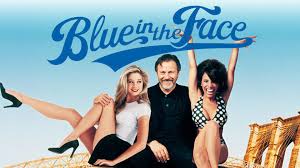
“Blue in the Face” (1995)
Drama

Running time: 89 minutes
Written by: Paul Auster and Wayne Wang
Directed by: Paul Auster and Wayne Wang
Featuring: Victor Argo, Giancarlo Esposito, Michael J. Fox, Mel Gorham, Jim Jarmusch, Harvey Keitel, Lou Reed,Roseanne, Mira Sorvino, Lily Tomlin and Malik Yoba
Man with Strange Glasses: “I’m scared 24 hours a day, but not necessarily in New York. I actually feel pretty comfortable in New York. I get scared like in Sweden. You know, it’s kind of empty. They’re all drunk. Everything works. If you, you know… If you stop at a stop light and don’t turn your engine off… people come over and talk to you about it. You open the medicine cabinet and there’ll be a poster saying… “In case of suicide, call…””
“Blue in the Face,” directed by Wayne Wang and Paul Auster, is a film that defies traditional categorization. Released in 1995, it’s a quasi-sequel to the critically acclaimed “Smoke,” but rather than continuing in the same narrative vein, “Blue in the Face” takes a radically different approach. This film is a cinematic experiment, an improvisational mosaic of ideas, conversations, and musings centered around a Brooklyn cigar shop. The result is a quirky, freewheeling piece of art that is as much about the neighborhood of Brooklyn as it is about the characters that inhabit it.
“Blue in the Face” was conceived and shot in just a few days, a testament to the spontaneity that defines the entire film. After finishing “Smoke,” Wang and Auster decided to keep the cameras rolling, inviting friends, actors, musicians, and locals to come by and contribute their thoughts, stories, and performances. The film feels like a lively neighborhood gathering, where everyone has something to say, and the conversation meanders in unexpected directions.
Unlike traditional films with a structured narrative, “Blue in the Face” is more of a collection of vignettes, loosely tied together by the setting of Auggie Wren’s (Harvey Keitel) cigar shop. The shop itself becomes a microcosm of Brooklyn, a place where people from all walks of life intersect, exchange stories, and share a laugh or a smoke. The film’s episodic nature means there’s no single storyline to follow, but rather a series of interconnected moments that together create a portrait of the neighborhood.
Harvey Keitel reprises his role as Auggie Wren, the affable, world-weary owner of the cigar shop. Keitel’s performance is understated yet compelling, grounding the film in a sense of continuity with “Smoke.” Auggie is the film’s anchor, providing a sense of stability amidst the chaotic swirl of characters and conversations. His interactions with the various customers and passersby reveal the richness of life in Brooklyn, a place where everyone has a story to tell.
The supporting cast is a mix of well-known actors and local personalities, each bringing their own flavor to the film. Lou Reed, the legendary musician, makes a memorable appearance, delivering a monologue about the changing face of New York City with his trademark deadpan delivery. Madonna, in a brief but hilarious cameo, plays a singing telegram girl, adding a touch of absurdity to the proceedings. Michael J. Fox, Lily Tomlin, and Jim Jarmusch are among the other recognizable faces that pop up throughout the film, each adding to the film’s eclectic, anything-goes atmosphere.
But it’s not just the celebrities that make “Blue in the Face” special. The film also features real Brooklynites, who bring authenticity and a sense of place to the film. Their stories, whether humorous, poignant, or bizarre, reflect the diversity and vitality of the neighborhood. It’s this mix of the famous and the ordinary, the scripted and the improvised, that gives the film its unique charm.
While the characters are central to “Blue in the Face,” the true star of the film is Brooklyn itself. The film is a love letter to the borough, celebrating its quirks, its history, and its ever-evolving identity. The film captures the spirit of Brooklyn in the mid-90s, a time when the neighborhood was undergoing significant changes. Gentrification, the rise of chain stores, and the fading of old-world traditions are recurring themes throughout the film.
The film’s title itself refers to the expression “blue in the face,” suggesting something done to the point of exhaustion or futility. In the context of the film, it reflects the sense of urgency and passion with which the characters—and the filmmakers—approach their lives and their art. Brooklyn is portrayed as a place where people are constantly striving, arguing, and debating, but always with a sense of love and pride for their neighborhood.
Visually, the film captures the vibrant energy of Brooklyn. The cinematography is unpolished and raw, reflecting the film’s improvised nature. The camera often lingers on the streets, the storefronts, and the people, creating a collage of images that together form a portrait of the neighborhood. The use of real locations and natural lighting adds to the film’s authenticity, making the viewer feel as if they are right there, walking the streets of Brooklyn.
“Blue in the Face” is a film that explores a wide range of themes, from the mundane to the profound. One of the most prominent themes is the idea of change, both personal and communal. The film grapples with the tension between the old and the new, the past and the future. Characters lament the loss of the “real” Brooklyn, with its mom-and-pop shops and close-knit communities, while also acknowledging the inevitability of change.
There’s also a strong sense of nostalgia that permeates the film. Many of the characters reflect on their past, whether it’s Auggie recalling his younger days or Lou Reed reminiscing about the New York of his youth. This nostalgia is tinged with a sense of loss, but also with a recognition of the beauty in the present moment. The film suggests that while things may change, the essence of a place—and its people—remains.
Another theme that runs through the film is the idea of community. “Blue in the Face” is a celebration of the connections that people form in their everyday lives. The cigar shop serves as a hub for these connections, a place where people come together, share their stories, and find comfort in each other’s company. The film highlights the importance of these small, everyday interactions in creating a sense of belonging and identity.
One of the most fascinating aspects of “Blue in the Face” is its improvisational nature. The film was made without a script, with the actors and filmmakers creating the scenes on the spot. This gives the film a sense of spontaneity and unpredictability that is rarely seen in mainstream cinema. The improvisation allows for moments of genuine humor, surprise, and emotion, as the actors react in real-time to each other and their surroundings.
This approach to filmmaking is risky, but it pays off in “Blue in the Face.” The film’s loose structure and freeform style create a sense of intimacy and immediacy, as if the viewer is eavesdropping on real conversations. The lack of a traditional narrative allows the film to explore a wide range of ideas and emotions, without being confined by the demands of plot or character arcs.
The improvisational style also reflects the themes of the film. Just as the characters are navigating the changes in their neighborhood, the filmmakers are navigating the challenges of making a film without a script. There’s a sense of playfulness and experimentation in the film, as if the filmmakers are testing the boundaries of what cinema can be. This makes “Blue in the Face” a unique and refreshing experience, even if it may not appeal to everyone.
“Blue in the Face” is not a film for everyone. Its lack of a traditional plot, its episodic structure, and its reliance on improvisation may be off-putting to some viewers. However, for those willing to embrace its quirks and idiosyncrasies, the film offers a rich and rewarding experience. It’s a film that celebrates the diversity, the energy, and the spirit of Brooklyn, capturing a moment in time with honesty and affection.
The film’s greatest strength is its ability to capture the essence of a place and its people. “Blue in the Face” is a film that is deeply rooted in its setting, and it’s this sense of place that gives the film its power. Whether it’s the conversations in the cigar shop, the monologues on the street, or the glimpses of everyday life, the film paints a vivid picture of Brooklyn in all its complexity.
In the end, “Blue in the Face” is a celebration of life in all its messy, unpredictable, and beautiful glory. It’s a film that invites the viewer to sit back, relax, and enjoy the ride, much like a leisurely walk through the streets of Brooklyn. It’s not a film that tells a story in the traditional sense, but rather a film that captures the spirit of a place and a moment in time. For that reason, it remains a unique and memorable piece of cinema.


 spryfilm.com