
“White Sands” (1992)
Drama

Running time: 101 minutes
Written by: Daniel Pyne
Directed by: Roger Donaldson
Featuring: Willem Dafoe, Mary Elizabeth Mastrantonio, Samuel L. Jackson and Mickey Rourke
Lane Bodine: “I’ve never met anyone like you… you’re honest, even when you lie.”
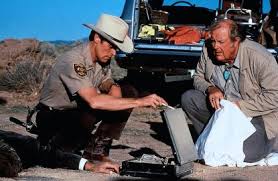
“White Sands,” directed by Roger Donaldson and released in 1992, is a neo-noir thriller that entices viewers with its intriguing premise and star-studded cast, yet ultimately falls short of its potential due to a convoluted plot and uneven pacing. The film features Willem Dafoe as Ray Dolezal, a small-town sheriff who stumbles upon a mysterious suitcase containing $500,000 and a dead body in the New Mexico desert. This discovery sets off a chain of events that pulls Dolezal into a dangerous web of deceit, corruption, and murder.
The film’s opening is promising, with stunning cinematography capturing the stark beauty of the New Mexico landscape. The imagery of the white sand dunes serves as a metaphor for the murky moral territory that Dolezal will navigate throughout the story. Willem Dafoe delivers a compelling performance as the naïve yet determined sheriff, showcasing his range as an actor and effectively portraying Dolezal’s transformation from a lawman with a strict moral code to a man willing to bend the rules to uncover the truth.
Mickey Rourke plays Gorman Lennox, a suave and enigmatic arms dealer who becomes Dolezal’s reluctant ally. Rourke’s performance is charismatic and menacing, adding a layer of complexity to the character. Mary Elizabeth Mastrantonio stars as Lane Bodine, a woman with her own hidden agenda, who adds an element of femme fatale to the mix. Samuel L. Jackson, in one of his earlier roles, portrays Greg Meeker, an FBI agent whose motives are as opaque as the desert sands.
The film’s narrative structure is both its strength and its Achilles’ heel. The labyrinthine plot twists and turns, keeping the audience guessing and creating a sense of suspense. However, the complexity of the story often leads to confusion, as multiple subplots and character motivations become tangled and difficult to follow. The script, penned by Daniel Pyne, is ambitious but sometimes sacrifices coherence for the sake of unpredictability.
One of the film’s standout aspects is its atmospheric score by Patrick O’Hearn. The music complements the film’s mood, enhancing the tension and underscoring the sense of isolation that permeates the desert setting. The score, combined with the film’s visual aesthetic, creates a palpable sense of unease that lingers throughout the movie.
Despite its stylistic strengths, “White Sands” suffers from uneven pacing. The film alternates between moments of intense action and slower, more introspective scenes. While this can be effective in building suspense, in “White Sands,” it often results in a disjointed viewing experience. The slow-burn approach requires patience, and the payoff may not be satisfying for all viewers.
The themes explored in “White Sands”—morality, deception, and the corrupting influence of money—are compelling, but the film’s execution leaves much to be desired. The characters, while intriguing, sometimes feel underdeveloped, and their motivations can be opaque. This lack of clarity can make it difficult for the audience to fully invest in their journeys.
While “White Sands” may not have achieved the acclaim it sought, it does offer moments of genuine intrigue and serves as a notable entry in the careers of its principal actors. Willem Dafoe’s portrayal of Ray Dolezal is particularly significant, showcasing his ability to embody a character who evolves under pressure. This transformation is central to the film’s narrative, illustrating how ordinary individuals can be drawn into extraordinary circumstances and forced to confront their own moral boundaries.
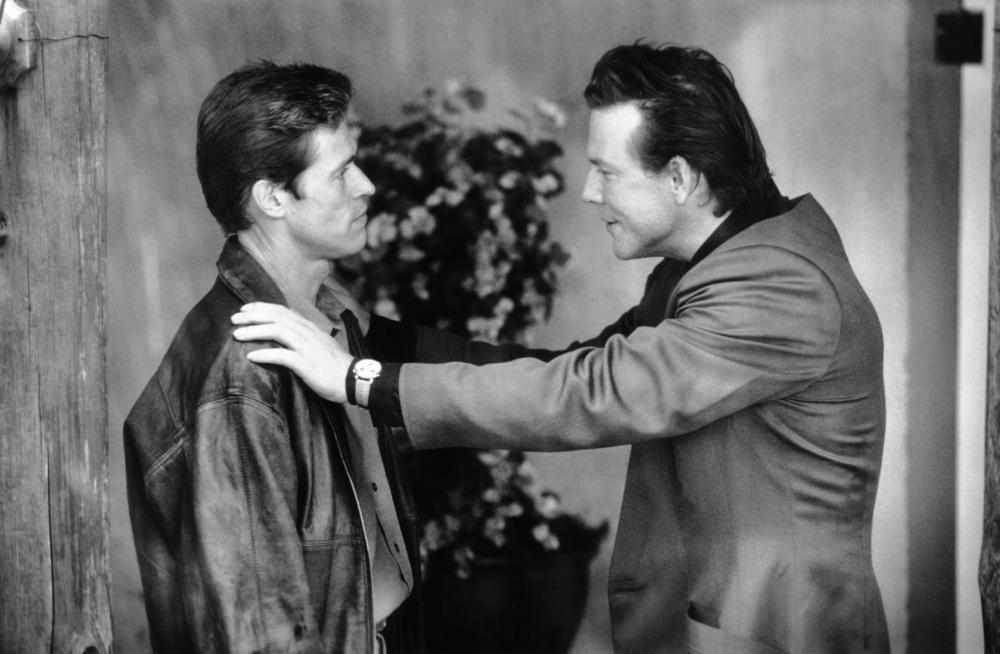
Mickey Rourke’s performance as Gorman Lennox is another highlight. Rourke brings a magnetic presence to the screen, playing Lennox with a blend of charm and menace that keeps viewers on edge. His interactions with Dafoe’s Dolezal are charged with tension, creating a dynamic that propels much of the film’s drama. Rourke’s ability to convey complexity and unpredictability in his character adds depth to the story, making Lennox a memorable antagonist.
Mary Elizabeth Mastrantonio’s Lane Bodine provides a compelling counterpoint to the male leads. As a character with her own agenda and secrets, Bodine is integral to the unfolding mystery. Mastrantonio’s performance is nuanced, capturing the duality of a woman who can be both vulnerable and manipulative. Her chemistry with Dafoe adds an additional layer of tension to the film, as Dolezal grapples with whether to trust her.
The supporting cast, including Samuel L. Jackson and M. Emmet Walsh, also deliver strong performances that contribute to the film’s overall atmosphere. Jackson’s portrayal of FBI agent Greg Meeker is particularly noteworthy, offering a glimpse of the intensity and charisma that would come to define his later roles. Walsh, as Dolezal’s deputy, provides a grounded presence that contrasts with the escalating chaos of the plot.
Director Roger Donaldson’s handling of the film’s aesthetic elements is commendable. The desert setting is not just a backdrop but a character in itself, with its vast, unforgiving expanse reflecting the isolation and moral ambiguity faced by the characters. The use of natural light and shadow enhances the noir feel of the film, creating a visual palette that is both stark and evocative.
Despite these strengths, “White Sands” is hampered by its narrative complexity. The plot’s numerous twists and turns, while initially engaging, can become overwhelming and difficult to follow. The film’s ambition to keep the audience guessing sometimes leads to a lack of coherence, making it challenging to fully grasp the stakes and relationships at play. This complexity, combined with the slow pacing, may test the patience of some viewers.
The film’s exploration of themes such as corruption, greed, and the fluid nature of identity is intriguing but not fully realized. The characters’ motivations are often shrouded in mystery, which can be both a strength and a weakness. While this ambiguity adds to the suspense, it can also leave the audience craving more clarity and depth in the characters’ arcs.
In the context of early ’90s cinema, “White Sands” stands out for its stylistic choices and strong performances, even if it does not achieve the narrative tightness of more celebrated thrillers of the time. It serves as a reminder of the era’s willingness to experiment with genre conventions and push the boundaries of traditional storytelling.
“White Sands” is a film that tantalizes with its potential but ultimately falters under the weight of its ambitious narrative. The performances, particularly those of Dafoe and Rourke, are noteworthy, and the film’s visual and auditory elements create a strong sense of atmosphere. However, the convoluted plot and uneven pacing prevent it from being a truly satisfying thriller. While it may not stand out as a classic in the neo-noir genre, “White Sands” remains an interesting watch for fans of complex, character-driven stories and those who appreciate the stylistic elements of early ’90s cinema.




 spryfilm.com