
“Lost Command” (1966)
War

Running Time: 97 minutes
Written by: Nelson Gidding
Directed by: Mark Robson
Featuring: Anthony Quinn, Alain Delon, George Segal, Michèle Morgan, Maurice Ronet, Claudia Cardinale and Grégoire Aslan
Merle: “A message from the airforce, sir. In 10 minutes, they will be overhead to drop in reinforcements!”
Lt. Col. Pierre Raspeguy: “We haven’t got enough firepower left to cover them, they’ll be slaughtered before they hit the ground, get back on the radio and warn them off.”
“Lost Command,” directed by Mark Robson, is a war film based on Jean Lartéguy’s 1960 novel “The Centurions.” The movie, starring Anthony Quinn, Alain Delon, George Segal, Michèle Morgan, and Maurice Ronet, delves into the complexities of military command and the moral ambiguities of war. Set against the backdrop of the French-Algerian War, the film explores themes of loyalty, sacrifice, and the psychological toll of combat.
Plot Synopsis
The story follows Lieutenant Colonel Pierre-Noel Raspéguy (Anthony Quinn), a tough and determined French officer who is captured by the Viet Minh during the First Indochina War. After his release, Raspéguy is tasked with leading a parachute battalion in Algeria, where he faces the formidable challenge of quelling the Algerian independence movement. Alongside him are Captain Philippe Esclavier (Alain Delon), a noble and idealistic officer; Lieutenant Mahidi (George Segal), an Algerian who sides with the rebels; and Captain Boisfeuras (Maurice Ronet), a ruthless and cunning soldier.
Quinn delivers a powerful performance as Raspéguy, embodying the character’s rugged determination and complex morality. Raspéguy is a man shaped by war, his leadership style characterized by a blend of paternalism and ruthless pragmatism. Quinn’s portrayal captures the internal conflicts of a soldier who must balance his duty to his country with the ethical implications of his actions.
Delon’s Esclavier is the moral compass of the film, representing the idealistic side of military service. His character’s journey from a naive officer to a disillusioned veteran is portrayed with subtlety and depth. Delon’s performance brings a sense of gravitas and introspection to the role, making Esclavier a compelling counterpart to Raspéguy.
Segal’s portrayal of Mahidi adds a layer of complexity to the narrative. As an Algerian who initially fights for the French, Mahidi’s eventual defection to the rebels highlights the personal and political conflicts inherent in colonial wars. Segal’s performance is both nuanced and passionate, effectively conveying Mahidi’s internal struggle and ultimate sense of betrayal.
Ronet’s Boisfeuras is a chilling depiction of the darker side of military operations. His character is ruthless and unrelenting, willing to employ any means necessary to achieve his objectives. Ronet’s performance is intense and menacing, providing a stark contrast to the more principled Esclavier.
“Lost Command” tackles the controversial subject of colonialism head-on, presenting a balanced view of the conflict. The film does not shy away from depicting the brutality of both the French forces and the Algerian rebels, highlighting the moral ambiguities of war. Raspéguy’s actions, while aimed at maintaining order, often cross ethical boundaries, prompting viewers to question the true cost of colonial rule.
The theme of loyalty is central to the film, with characters constantly grappling with their allegiances. Raspéguy’s loyalty to his men and his country is tested against the backdrop of a war that lacks clear moral boundaries. Mahidi’s shift in loyalty from the French to the Algerian rebels underscores the personal conflicts faced by individuals caught in the crossfire of political upheaval.
The film delves into the psychological toll of combat on soldiers. Raspéguy, Esclavier, and Mahidi each experience the war’s impact on their psyche in different ways. Raspéguy’s hardened exterior masks his internal turmoil, Esclavier’s idealism is eroded by the harsh realities of war, and Mahidi’s sense of identity is torn apart by conflicting loyalties. “Lost Command” portrays these psychological struggles with a raw honesty that adds depth to the narrative.
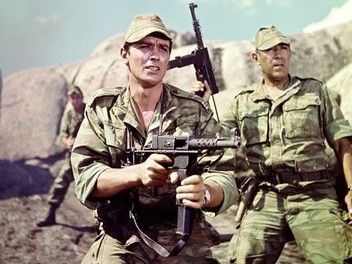
Mark Robson’s direction is adept at balancing the film’s action sequences with its more introspective moments. The battle scenes are gritty and intense, capturing the chaos and violence of guerilla warfare. In contrast, the quieter scenes allow for character development and reflection, giving the film an emotional resonance.
Cinematographer Robert Surtees excels in capturing the stark beauty of the Algerian landscape. The use of wide shots and natural lighting enhances the film’s realism, immersing viewers in the harsh environment faced by the soldiers. The visual contrast between the lush jungles of Indochina and the arid deserts of Algeria underscores the diverse challenges encountered by the French forces.
The film’s score, composed by Franz Waxman, complements the narrative with its dramatic and evocative themes. The music underscores the tension and drama of the battle scenes, while also providing a poignant backdrop for the more reflective moments. The sound design is equally effective, with the sounds of gunfire and explosions adding to the film’s immersive quality.
“Lost Command” is a compelling war film that offers a nuanced portrayal of the French-Algerian War. Through its complex characters and unflinching examination of moral ambiguity, the film provides a thought-provoking commentary on the nature of colonialism and the psychological impact of combat. The strong performances, particularly by Anthony Quinn and Alain Delon, coupled with Mark Robson’s skilled direction, make “Lost Command” a powerful and enduring work of cinema. It is a film that challenges viewers to reflect on the ethical dimensions of war and the human cost of political conflict.



 spryfilm.com