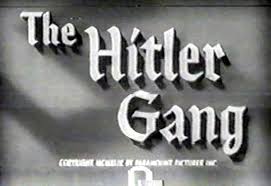
“The Hitler Gang ” (1944)
Drama

Running Time: 100 minutes
Written by: Frances Goodrich and Albert Hackett
Directed by: John Farrow
Captain Ernst Röhm: “Gerlich has shot himself.”
Streicher: “He’s the first man who shot himself in the head six times.”
“The Hitler Gang,” directed by John Farrow in 1944, is a fascinating yet controversial film that delves into the rise of Adolf Hitler and the Nazi Party in Germany. As a historical drama, it aims to provide audiences with insight into the political and social conditions that paved the way for Hitler’s ascent to power and the atrocities committed during his regime. However, it’s important to approach this film with a critical eye, considering its context and the challenges of depicting such sensitive subject matter.
First and foremost, it’s crucial to acknowledge the historical significance of “The Hitler Gang.” Released during World War II, the film served as a piece of wartime propaganda, intended to rally support for the Allied cause by portraying Hitler and the Nazis in a negative light. As such, it presents a highly dramatized and often sensationalized version of events, with little regard for historical accuracy.
The film follows Hitler’s trajectory from his early days as a struggling artist in Vienna to his eventual rise to power as Chancellor of Germany. Along the way, it depicts his ruthless ambition, manipulation of the masses, and the violent tactics employed by the Nazi Party to suppress dissent and consolidate power. While some scenes are undoubtedly powerful and thought-provoking, others veer into melodrama, sacrificing nuance for the sake of dramatic effect.
One of the film’s most notable strengths is its cast, particularly the performance of Bobby Watson in the role of Adolf Hitler. Watson captures Hitler’s charisma and fanaticism with chilling precision, portraying him as a complex and multifaceted character rather than a one-dimensional villain. Similarly, the supporting cast delivers solid performances, bringing to life key figures such as Joseph Goebbels, Hermann Göring, and Heinrich Himmler.
Visually, “The Hitler Gang” is a mixed bag. While the production values are generally high for a film of its time, some scenes suffer from dated special effects and stagey set design. Additionally, the decision to film in black and white, while appropriate for the era, may limit its appeal to modern audiences accustomed to more vibrant cinematography.
Perhaps the most contentious aspect of “The Hitler Gang” is its portrayal of historical events. While the film provides a basic overview of Hitler’s rise to power, it takes significant liberties with the facts, inventing dialogue and conflating events for the sake of narrative cohesion. This approach may be frustrating for viewers seeking a more accurate portrayal of history, but it’s important to remember that the film was intended primarily as propaganda rather than as a work of scholarly analysis.
Beyond its historical and cinematic merits, “The Hitler Gang” also prompts important discussions about the ethics of portraying real-life atrocities on screen. The film walks a fine line between providing necessary historical context and potentially glorifying or sensationalizing the actions of its subjects. This raises questions about the responsibility of filmmakers to accurately represent historical events and the potential consequences of misrepresentation or distortion.
Moreover, “The Hitler Gang” serves as a stark reminder of the dangers of propaganda and the manipulation of mass media for political purposes. By examining the methods employed by Hitler and the Nazis to sway public opinion and suppress dissent, the film underscores the importance of critical thinking and media literacy in safeguarding against the rise of authoritarianism and extremism.
Additionally, the film’s release during World War II adds another layer of complexity to its legacy. As a piece of wartime propaganda, it must be viewed within the context of its production and distribution, which were heavily influenced by political and military objectives. This raises questions about the role of art in times of conflict and the potential for film to serve as both a tool for propaganda and a vehicle for truth and justice.
Despite its shortcomings, “The Hitler Gang” remains a significant cultural artifact that continues to spark debate and discussion among historians, filmmakers, and audiences alike. Its portrayal of Hitler and the Nazi Party may be flawed, but it serves as a reminder of the enduring legacy of one of the darkest chapters in human history.
Furthermore, beyond its historical and ethical implications, “The Hitler Gang” underscores the power of cinema to shape perceptions and influence public opinion. As a medium of storytelling, film has the ability to evoke emotion, provoke thought, and inspire action. In the case of “The Hitler Gang,” its portrayal of Hitler and the Nazis as sinister and malevolent figures undoubtedly played a role in galvanizing support for the Allied cause during World War II.
However, the film’s legacy extends beyond its immediate impact on wartime audiences. It continues to be studied and analyzed by scholars, filmmakers, and historians as a reflection of the era in which it was produced. By examining the techniques used to depict historical events and the underlying messages conveyed, researchers can gain insights into the broader cultural and political climate of the time.
Moreover, “The Hitler Gang” serves as a cautionary tale about the dangers of totalitarianism and the erosion of democratic norms. By highlighting the tactics employed by Hitler and the Nazis to subvert democracy and consolidate power, the film underscores the importance of safeguarding democratic institutions and upholding the values of freedom, equality, and justice.
In today’s world, where authoritarianism and extremism continue to pose significant threats to global stability and security, the lessons of “The Hitler Gang” remain as relevant as ever. By grappling with the complexities of its portrayal of history and engaging in critical dialogue about its themes and messages, audiences can gain a deeper understanding of the forces that shape our world and the responsibilities we bear as citizens of a democratic society.
“The Hitler Gang” is a flawed yet intriguing film that offers a window into the propaganda efforts of World War II. While its portrayal of historical events may be questionable, it remains a valuable artifact of its time, serving as a reminder of the power of cinema to shape public opinion. For those interested in exploring the complexities of Hitler’s rise to power, it’s worth a watch, but viewers should approach it with caution and a critical mindset.
Special Features & Technical Specs:
- 1080p High-definition presentation on Blu-ray
- Commentary by film historians Daniel Kremer and Allan Arkush (2024)
- Master Of Invention – Video Essay by filmmaker and critic David Cairns (2024)
- The Rise of a Dictator – Teaching Custodians educational film (1944)
- Audio LPCM 2.0 Mono
- Original Aspect Ratio TBC
- Optional English HOH Subtitles
 spryfilm.com