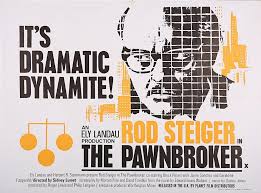
“The Pawnbroker” (1964)
Drama

Running Time: 116 minutes
Written by: Morton S. Fine and David Friedkin based on the book by Edward Lewis Wallant
Featuring: Rod Steiger, Geraldine Fitzgerald, Brock Peters, Jaime Sánchez and Thelma Oliver
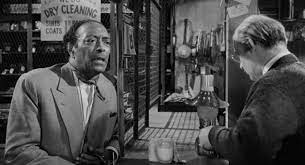
Jesus Ortiz: “Say, how come you people come to business so naturally?”
Sol Nazerman: “You people? Oh, let’s see. Yeah. I see. I see, you… you want to learn the secret of our success, is that right? Alright I’ll teach you. First of all you start off with a period of several thousand years, during which you have nothing to sustain you but a great bearded legend. Oh my friend you have no land to call your own, to grow food on or to hunt. You have nothing. You’re never in one place long enough to have a geography or an army or a land myth. All you have is a little brain. A little brain and a great bearded legend to sustain you and convince you that you are special, even in poverty. But this little brain, that’s the real key you see. With this little brain you go out and you buy a piece of cloth and you cut that cloth in two and you go and sell it for a penny more than you paid for it. Then you run right out and buy another piece of cloth, cut it into three pieces and sell it for three pennies profit. But, my friend, during that time you must never succumb to buying an extra piece of bread for the table or a toy for a child, no. You must immediately run out and get yourself a still larger piece cloth and so you repeat this process over and over and suddenly you discover something. You have no longer any desire, any temptation to dig into the Earth to grow food or to gaze at a limitless land and call it your own, no, no. You just go on and on and on repeating this process over the centuries over and over and suddenly you make a grand discovery. You have a mercantile heritage! You are a merchant. You are known as a usurer, a man with secret resources, a witch, a pawnbroker, a sheenie, a makie and a kike!”
Jesus Ortiz: [long pause] “You really some teacher, Mr. Nazerman. You really, really ‘s the greatest.”
“The Pawnbroker” is a poignant exploration of human suffering, trauma, and redemption, directed by Sidney Lumet and released in 1964. Set in Harlem, the film follows Sol Nazerman, played masterfully by Rod Steiger, a Holocaust survivor who operates a pawnshop. The narrative delves into Nazerman’s internal struggles as he grapples with his traumatic past while navigating the harsh realities of his present environment.
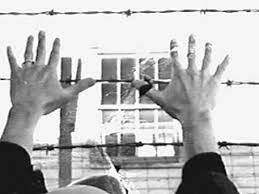
Lumet’s direction in “The Pawnbroker” is both sensitive and unflinching, capturing the raw emotions of its characters and the bleakness of their surroundings. The use of flashbacks to Nazerman’s experiences in the concentration camps is particularly effective, highlighting the enduring impact of trauma on his psyche. Through these flashbacks, the film confronts the horrors of the Holocaust head-on, refusing to shy away from its brutality.
Central to the film’s success is Rod Steiger’s powerhouse performance as Sol Nazerman. Steiger brings depth and complexity to the character, portraying Nazerman as a man haunted by his past yet emotionally detached from the world around him. His portrayal captures the character’s inner turmoil with nuance, making Nazerman a deeply compelling and sympathetic figure despite his flaws.
“The Pawnbroker” also deserves praise for its exploration of themes such as alienation, loss, and the search for meaning in the face of adversity. The supporting cast, including Geraldine Fitzgerald as Nazerman’s assistant and Jaime Sánchez as a troubled young man drawn to the pawnshop, deliver strong performances that enhance the film’s emotional resonance.
However, “The Pawnbroker” is not without its flaws. Some critics have pointed to its occasionally heavy-handed symbolism and melodramatic moments as detracting from its overall impact. Additionally, the film’s portrayal of race and poverty has been criticized for perpetuating stereotypes and lacking nuance.
One aspect that deserves further examination is the film’s depiction of urban decay and the socio-economic struggles of its characters. Set against the backdrop of 1960s Harlem, “The Pawnbroker” presents a bleak and desolate landscape marked by poverty, crime, and despair. Lumet’s cinematography effectively captures the grittiness of the neighborhood, immersing viewers in a world where hope seems in short supply.
Through Nazerman’s interactions with his customers and the community at large, the film sheds light on the systemic issues that perpetuate poverty and marginalization. From the desperate individuals pawning their belongings to survive to the young men drawn into lives of crime, “The Pawnbroker” portrays a society where opportunities for advancement are scarce and the cycle of poverty is difficult to escape.
Moreover, the film’s examination of identity and cultural assimilation adds another layer of complexity to its narrative. As a Jewish immigrant who survived the Holocaust, Nazerman grapples with feelings of displacement and disconnection from both his past and present. His refusal to confront his trauma and engage with the world around him reflects a broader theme of alienation and isolation prevalent among survivors of historical trauma.
At its core, “The Pawnbroker” is a deeply human story that transcends its specific time and place. It speaks to the universal experiences of suffering, resilience, and the search for meaning in a seemingly indifferent world. By confronting difficult subject matter with honesty and empathy, the film invites viewers to reflect on their own capacity for compassion and understanding.
Furthermore, one of the film’s most striking elements is its exploration of memory and the ways in which the past continues to exert its influence on the present. Through Nazerman’s fragmented recollections of his time in the concentration camps, the film highlights the enduring trauma of his experiences and the ways in which they shape his interactions with the world around him. These haunting flashbacks serve as a reminder of the indelible scars left by the Holocaust and the profound impact it had on the lives of survivors like Nazerman.
The juxtaposition of Nazerman’s memories with his daily life in Harlem underscores the interconnectedness of past and present, suggesting that the past is never truly buried but rather lurks beneath the surface, ready to resurface at any moment. This theme is further reinforced by the recurring motif of mirrors throughout the film, which symbolize both reflection and introspection. In one particularly poignant scene, Nazerman gazes into a mirror, confronting his own haunted reflection as he grapples with the weight of his memories.
Moreover, “The Pawnbroker” challenges viewers to confront uncomfortable truths about the human capacity for cruelty and suffering. Through Nazerman’s experiences in the concentration camps and the various forms of oppression and exploitation he witnesses in Harlem, the film forces audiences to reckon with the darker aspects of human nature. In doing so, it compels viewers to reflect on their own role in perpetuating or combatting injustice and oppression in the world.
Furthermore, the character of Sol Nazerman serves as a powerful symbol of resilience and redemption amidst unimaginable suffering. Despite his emotional detachment and apparent cynicism, Nazerman’s gradual awakening to the humanity around him offers a glimmer of hope in an otherwise bleak narrative. Through his interactions with individuals like Jesus Ortiz, a troubled young man seeking guidance, and Marilyn Birchfield, a compassionate social worker determined to help him confront his past, Nazerman begins to confront his own demons and find a measure of healing.
The film’s denouement, which sees Nazerman finally breaking down in tears as he confronts the full extent of his pain and loss, is a cathartic moment that encapsulates the film’s central themes of redemption and reconciliation. In this moment of vulnerability, Nazerman transcends his stoic façade and embraces his humanity, symbolizing the possibility of healing and renewal even in the face of unspeakable tragedy.
In addition to its thematic depth and emotional resonance, “The Pawnbroker” is also notable for its technical achievements, including Ernest Kinoy’s powerful screenplay and Quincy Jones’s evocative musical score. Kinoy’s script deftly navigates complex themes and character dynamics, while Jones’s haunting score enhances the film’s emotional impact, complementing Lumet’s masterful direction and Steiger’s unforgettable performance.
Despite these criticisms, “The Pawnbroker” remains a powerful and thought-provoking film that continues to resonate with audiences today. Its exploration of trauma and redemption, coupled with stellar performances and evocative direction, make it a timeless classic worthy of critical acclaim.



 spryfilm.com