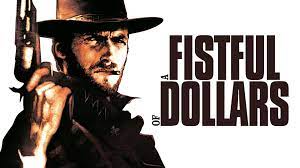
“A Fistful of Dollars” (1964)
Western

Running Time: 99 minutes
Directed by: Sergio Leone
Featuring: Clint Eastwood, Marianne Koch, Josef Egger, Wolfgang Lukschy, Gian Maria Volonté, Daniel Martín, Bruno Carotenuto and Benito Stefanelli
Joe: “When a man’s got money in his pocket he begins to appreciate peace.”
Critical Commentary
“A Fistful of Dollars” is an iconic spaghetti western film directed by Sergio Leone and released in 1964. This movie not only marked the beginning of the famous Dollars Trilogy but also revitalized the western genre with its gritty realism, stylish cinematography, and unforgettable performances. Set in the backdrop of a lawless border town, the film follows the mysterious stranger, played by Clint Eastwood in his breakthrough role, as he manipulates rival factions in a bid to profit from their conflicts.
Leone’s direction in “A Fistful of Dollars” is masterful, showcasing his signature style of long, tension-filled shots, close-ups, and sweeping landscapes. The use of extreme close-ups to capture the characters’ facial expressions adds depth to the narrative, allowing the audience to delve into the psyche of the morally ambiguous protagonist and the ensemble cast of colourful characters populating the frontier town.
The film’s screenplay, written by Leone, Víctor Andrés Catena, and Jaime Comas Gil, is a reimagining of Akira Kurosawa’s samurai film “Yojimbo.” However, “A Fistful of Dollars” transplants the story into the American West, infusing it with the sensibilities of the spaghetti western genre. The dialogue is sparse yet impactful, with Eastwood’s iconic one-liners becoming legendary in cinematic history. The plot is simple yet engaging, revolving around the stranger’s manipulation of two rival families, the Rojos and the Baxters, as he plays them against each other for his own gain.
One of the film’s most significant contributions to cinema is its ground-breaking score by Ennio Morricone. The iconic main theme, featuring twangy guitars, haunting whistles, and stirring trumpets, perfectly captures the essence of the Wild West and elevates the film’s atmosphere to mythical proportions. Morricone’s score is not just a background accompaniment but a character in itself, heightening the tension and emotion in every scene.
At the heart of “A Fistful of Dollars” is Clint Eastwood’s portrayal of the enigmatic stranger, often referred to as “The Man with No Name.” With his steely gaze, stoic demeanour, and cool demeanour, Eastwood embodies the archetypal anti-hero, a morally ambiguous figure driven by self-interest yet possessing a sense of justice. His performance laid the groundwork for the archetype of the lone gunslinger that would define his career and influence countless other films in the genre.
The supporting cast, including Gian Maria Volontè as the ruthless Ramón Rojo and Marianne Koch as the innkeeper Marisol, delivers strong performances that complement Eastwood’s presence on screen. Volontè’s portrayal of the volatile and unpredictable Ramón is particularly memorable, serving as the perfect foil to Eastwood’s calm and collected protagonist.
Visually, “A Fistful of Dollars” is a feast for the eyes, with Leone and cinematographer Massimo Dallamano crafting stunning compositions that capture the harsh beauty of the desert landscape. From sweeping vistas of the dusty frontier town to intimate close-ups of characters’ faces, every frame is meticulously composed, adding to the film’s immersive atmosphere.
In addition to its technical and artistic achievements, “A Fistful of Dollars” also explores deeper themes of greed, revenge, and the corrupting influence of power. Through its portrayal of a lawless frontier town where justice is elusive and morality is fluid, the film offers a commentary on the darker aspects of human nature and the consequences of unchecked ambition.
“A Fistful of Dollars” not only reshaped the western genre but also had a significant impact on filmmaking as a whole. Its unconventional narrative structure, anti-hero protagonist, and stylized violence paved the way for a new wave of gritty, morally complex cinema. The film’s success inspired countless imitators and cemented the popularity of the spaghetti western subgenre, with filmmakers from around the world drawing inspiration from Leone’s aesthetic and storytelling techniques.
One of the most remarkable aspects of “A Fistful of Dollars” is its ability to transcend language and cultural barriers. Despite being an Italian production filmed in Spain, the film’s universal themes of greed, betrayal, and redemption resonate with audiences across the globe. Its minimalist dialogue and visual storytelling allow the film to communicate its message effectively to viewers of all backgrounds, making it a true testament to the power of cinema as a universal language.
Moreover, “A Fistful of Dollars” is a product of its time, reflecting the social and political climate of the 1960s. The film’s portrayal of a lawless frontier town rife with corruption and violence can be seen as a commentary on the tumultuous era of political unrest and social upheaval. By depicting a world where justice is elusive and moral ambiguity reigns supreme, Leone invites viewers to confront the darker aspects of human nature and the consequences of unchecked power.
The film’s enduring popularity can also be attributed to its influence on popular culture. Countless references and homages to “A Fistful of Dollars” can be found in music, literature, television, and other films. Its iconic imagery, memorable quotes, and distinctive style have left an indelible mark on the collective consciousness, ensuring its place in the pantheon of cinematic classics for generations to come.
“A Fistful of Dollars” is a timeless classic that continues to captivate audiences with its electrifying action, memorable characters, and stylish direction. Sergio Leone’s visionary filmmaking, Ennio Morricone’s unforgettable score, and Clint Eastwood’s iconic performance combine to create a cinematic experience that transcends its genre and remains a landmark in the history of cinema. Whether you’re a fan of westerns or simply appreciate great filmmaking, “A Fistful of Dollars” is essential viewing.
Technical Commentary
Video
For “A Fistful of Dollars,” ViaVision has apparently decided to step away from any overt tinkering, leaving the AVC encoded image (2.35:1 aspect ratio) presentation to the controversial colour work, which also favours bold reds. For those who enjoy the heightened look, the viewing experience is certainly supported with detail, offering a textured look at the meaty faces that populate the movie, while locations remain dimensional. Costuming stays fibrous. Delineation struggles at times with solidification. Grain is fine and filmic. Source is in strong shape, without any significant areas of concern.
Audio
The 2.0 DTS-HD MA sound mix offers a brighter, louder listening experience for the film, and while hiss is present during the presentation, it’s not a distraction. Music is a highlight, coming through with authority and precise instrumentation.
Special Features
- Audio commentary by Sir Christopher Frayling
- “A New Kind of Hero: Sir Christopher Frayling on Fistful of Dollars” – featurette
- “Tre Voci / Three Voices: Three Friends Remember Sergio Leone” – featurette”
- A Few Weeks in Spain: Clint Eastwood on Fistful of Dollars” – featurette
- “The Network Prologue: Broadcast Before Fistful of Dollars” – featurette
- “Not Ready for Primetime: The Lost Prologue to Fistful of Dollars” – featurette
- “Fistful of Dollars Location Comparisons: Almeria, Spain 1964-2004” – featurette
- 10 Radio Spots
- Double Bill Trailer
- “Collector’s Gallery” photo gallery


 spryfilm.com