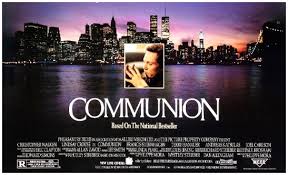
“Communion” (1989)
Drama

Running Time: 105 minutes
Written by: Whitley Strieber
Directed by: Philippe Mora
Featuring: Christopher Walken, Lindsay Crouse, Frances Sternhagen, Terry Hanauer, Andreas Katsulas and Joel Carlson
Whitley Strieber: “Was there an owl in here last night?”
Critical Commentary
“Communion” is a thought-provoking and enigmatic science fiction film that delves into the realms of extra-terrestrial encounters and the profound impact they can have on an individual’s life. Released in 1989 and directed by Philippe Mora, the movie is based on the bestselling book of the same name by Whitley Strieber, who claims to have had real-life experiences with alien beings.
The film stars Christopher Walken in the lead role as Whitley Strieber, a successful author who, along with his family, experiences a series of inexplicable and terrifying events that lead him to question the nature of reality and his own sanity. What sets “Communion” apart from typical alien-themed movies is its focus on the psychological and emotional toll that these encounters take on the protagonist.
Christopher Walken delivers a compelling and nuanced performance as Strieber, capturing the character’s emotional journey from scepticism to fear, and ultimately to a complex acceptance of the inexplicable events that unfold. Walken’s ability to convey the inner turmoil and vulnerability of Strieber adds depth to the narrative, making the audience empathize with the character’s struggle to reconcile the extraordinary experiences with the scepticism of the outside world.
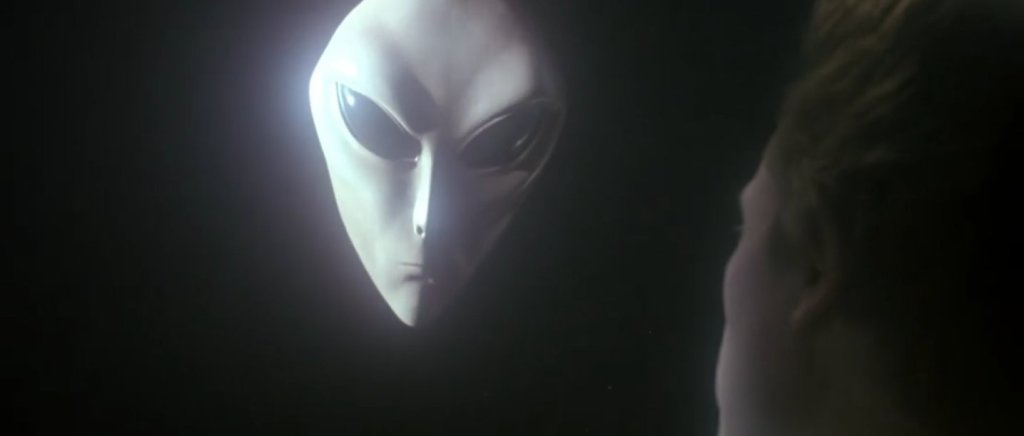
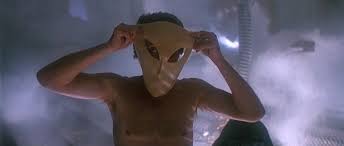
The film’s cinematography and visual effects, while dated by today’s standards, effectively convey the eerie and unsettling atmosphere surrounding Strieber’s encounters. The use of practical effects and prosthetics in depicting the alien beings adds a visceral and unsettling quality to the film, enhancing the overall sense of unease.
One of the strengths of “Communion” lies in its willingness to explore the psychological and existential aspects of alien abduction experiences. The movie delves into themes of trauma, memory, and the impact of the unknown on human consciousness. It successfully avoids falling into the trap of clichéd extra-terrestrial tropes and instead opts for a more introspective and character-driven narrative.
The supporting cast, including Lindsay Crouse as Anne Strieber and Frances Sternhagen as Dr. Janet Duffy, contributes solid performances that help ground the film in a sense of reality. The relationships and interactions between characters serve to humanize the story, making the audience invest emotionally in the central mystery.
The film’s soundtrack, composed by Eric Clapton, complements the eerie and mysterious tone of the narrative. Clapton’s music adds an otherworldly quality to the film, enhancing the suspense and drama of Strieber’s journey.
While “Communion” received mixed reviews upon its initial release, its enduring appeal lies in its unique approach to the alien abduction genre. Rather than relying solely on spectacle and action, the film engages with the psychological and emotional impact of extra-terrestrial experiences. It encourages viewers to ponder the mysteries of the universe and the limitations of human understanding.
The film unfolds as a psychological journey, mirroring Strieber’s own struggle to reconcile the bizarre events that disrupt his seemingly idyllic life. As the narrative progresses, viewers are taken on a rollercoaster of emotions, from the initial disbelief and terror to the gradual acceptance of an otherworldly reality. The screenplay, adapted by Whitley Strieber himself, offers a glimpse into the inner workings of a mind grappling with the unimaginable, blurring the lines between reality and perception.
The supporting characters in “Communion” play pivotal roles in both challenging and reinforcing Strieber’s experiences. Lindsay Crouse as Anne Strieber provides a convincing portrayal of a supportive yet sceptical wife trying to comprehend her husband’s increasingly erratic behaviour. The dynamic between Christopher Walken and Crouse adds a layer of authenticity to the film, showcasing the strain that such extraordinary events can place on personal relationships.
Frances Sternhagen’s performance as Dr. Janet Duffy, a psychologist attempting to unravel the mysteries behind Strieber’s encounters, adds a touch of scientific inquiry to the narrative. The inclusion of Duffy’s character not only introduces an element of rational analysis but also serves as a conduit for the audience to question the veracity of Strieber’s experiences. This blend of psychological drama and scientific inquiry adds depth to the storytelling, preventing the film from descending into a mere spectacle of the supernatural.
The film’s pacing is deliberate, allowing the tension to build gradually, mirroring Strieber’s own sense of unease and disorientation. Philippe Mora’s direction emphasizes atmospheric elements, utilizing shadows, lighting, and sound design to create an unsettling ambiance. The visual and auditory cues heighten the suspense, keeping the audience on edge as they follow Strieber’s descent into the unknown.
“Communion” doesn’t shy away from exploring the more esoteric aspects of Strieber’s encounters, incorporating elements of mysticism and the metaphysical. This willingness to embrace ambiguity and leave certain questions unanswered contributes to the film’s enduring mystique. The narrative’s refusal to provide easy answers challenges viewers to engage with the material on a deeper level, sparking conversations about the nature of belief, the limits of human understanding, and the existence of phenomena beyond our comprehension.
While some critics may fault “Communion” for its departure from conventional storytelling and its reliance on subjective experiences, these very elements contribute to its enduring appeal. The film serves as a testament to the complexity of the human mind and its capacity to grapple with the inexplicable. It invites audiences to consider the possibility that there are facets of existence that defy conventional explanation, encouraging a more open-minded approach to the mysteries that surround us.
“Communion” is a thought-provoking and atmospheric film that explores the intersection of the unknown and the human psyche. Christopher Walken’s powerful performance, coupled with the film’s introspective approach, elevates it beyond typical science fiction fare. Whether one believes in extra-terrestrial encounters or not, “Communion” remains a captivating exploration of the mysteries that lie beyond the boundaries of our understanding.
Technical Commentary
Video
The AVC encoded image (2.36:1 aspect ratio) presentation for “Communion” appears to be sourced from an older master of the film. Detail is on the soft side, but skin particulars are appreciable on human characters and alien visions, which retain their rubbery appearance. Household interiors are open for examination, along with misty, metallic ship visits. Colours are slightly muted, but the cooler palette for “Communion” remains intact, tracking evening experiences and dimly lit encounters.
Audio
The 2.0 DTS-HD MA mix delivers decent dialogue exchanges, with nothing lost along the way. Atmospherics are appreciable, with a louder sense of alien action and steamy environments.
Special Features
- Audio Commentary by Film Historian/Screenwriter Gary Gerani (2023)
- Audio Commentary by Director Philippe Mora and William J. Birnes, publisher of UFO Magazine
- Outtakes
- Behind-the-scenes Footage
- Theatrical Trailers
- Excerpt from “According to Occam’s Razor” – actual videotape footage of an alien implant removal



 spryfilm.com