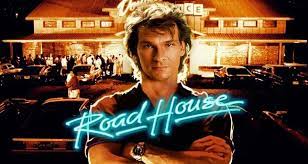
“Road House” (1989)
Action

Running Time: 114 minutes
Written by: David Lee Henry and Hilary Henkin
Directed by: Rowdy Herrington
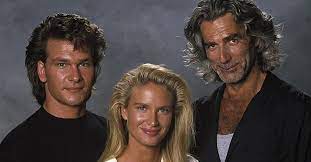
Featuring: Patrick Swayze, Ben Gazzara, Kelly Lynch and Sam Elliott
Dalton: “Take the biggest guy in the world, shatter his knee and he’ll drop like a stone.”
Critical Commentary
“Road House,” released in 1989, directed by Rowdy Herrington, is a film that has left an indelible mark on the action genre. Starring Patrick Swayze as the enigmatic and stoic Dalton, the movie takes us on a thrilling journey through the world of roadside bars, corrupt towns, and the explosive blend of romance and violence. From the neon-lit bars to the gravel-strewn streets, “Road House” is a cinematic rollercoaster that transcends the typical action movie tropes.
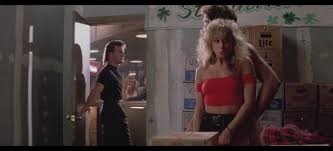
The plot revolves around Dalton, a legendary bouncer with a Zen-like philosophy, who is hired to clean up the notorious Double Deuce, a bar in the small town of Jasper. As Dalton attempts to restore order and bring justice to the town, he finds himself entangled in a web of corruption, crime, and personal vendettas. The narrative seamlessly weaves together action, romance, and drama, making “Road House” more than just a typical action flick.
At the heart of the film is Patrick Swayze’s portrayal of Dalton. Swayze brings a unique blend of charm, physical prowess, and brooding intensity to the character, making Dalton more than just a bouncer with a philosophy – he becomes a symbol of justice. Swayze’s on-screen chemistry with Kelly Lynch, who plays the role of the local doctor and Dalton’s love interest, adds depth to the film. The supporting cast, including Sam Elliott as Dalton’s mentor and Ben Gazzara as the menacing villain Brad Wesley, further elevates the ensemble.
“Road House” is renowned for its intense and well-choreographed action sequences. From the gritty barroom brawls to the high-octane showdowns, the film delivers a visceral and adrenaline-pumping experience. The fight scenes are not just about physicality; they serve as a narrative device, showcasing Dalton’s skills and the underlying tension in the town. Swayze’s background in dance brings a unique grace to the fight scenes, making them stand out in the action genre.
The film’s visual aesthetics, captured by cinematographer Dean Cundey, contribute significantly to its overall impact. The neon lights of the Double Deuce, the dusty roads of Jasper, and the atmospheric lighting during the action scenes create a distinct visual identity for “Road House.” The setting feels like a character in itself, adding authenticity to the small-town atmosphere and enhancing the film’s immersive quality.
The soundtrack of “Road House” complements the film’s rugged ambiance, featuring classic rock tunes that become synonymous with the era. The musical choices, including tracks by The Jeff Healey Band, enhance the emotional beats of the narrative and provide a memorable backdrop to the on-screen action.
Beneath the surface-level action and romance, “Road House” explores themes of justice, redemption, and the complexity of human nature. Dalton’s philosophy, rooted in Eastern wisdom and martial arts, adds a layer of depth to the character and elevates the film beyond a mere action spectacle.
One of the standout aspects of “Road House” is its rich character dynamics and relationships. The camaraderie between Dalton and his mentor, Wade Garrett, played with seasoned charm by Sam Elliott, adds emotional depth to the film. Their shared history and the mutual respect between the characters enhance the narrative, providing a nuanced exploration of loyalty and brotherhood.
The romantic subplot between Dalton and Dr. Elizabeth “Doc” Clay, portrayed by Kelly Lynch, is more than just a clichéd love interest angle. The chemistry between Swayze and Lynch feels genuine, and the budding romance unfolds organically amidst the chaos of the Double Deuce and the town’s tumultuous atmosphere. This love story is not a mere subplot; it becomes an integral part of Dalton’s journey, driving him to confront not only external threats but also his own vulnerabilities.
Ben Gazzara’s portrayal of Brad Wesley, the town’s corrupt and powerful antagonist, is a masterclass in villainy. Gazzara’s charismatic yet menacing performance makes Wesley a memorable foe. His control over the town, both economically and through sheer intimidation, sets the stage for Dalton’s crusade for justice. The film’s exploration of corruption in a small town adds a layer of social commentary, making the stakes more significant than just barroom brawls.
“Road House” is peppered with memorable lines and iconic quotes that have become ingrained in pop culture. Dalton’s stoic wisdom, delivered with Swayze’s trademark intensity, is balanced by witty and often humorous exchanges between the characters. The dialogue serves as a vehicle for character development, adding depth to the personas in the midst of the chaos.
While “Road House” may not have received unanimous critical acclaim upon its initial release, it has since attained cult status. The film’s influence on subsequent action movies is evident in its blending of martial arts, Western tropes, and a touch of film noir. Its impact is felt in the way it pushed the boundaries of the action genre, proving that a film could be both thrilling and thought-provoking.
“Road House” remains a testament to the late Patrick Swayze’s versatility as an actor. Swayze’s ability to seamlessly transition from dramatic moments to high-energy action scenes showcases his range. His portrayal of Dalton endears the character to audiences, making him an enduring figure in the realm of action cinema.
“Road House” stands the test of time as a cult classic, celebrated for its charismatic performances, intense action sequences, and a narrative that transcends the boundaries of traditional action cinema. Patrick Swayze’s iconic portrayal of Dalton, combined with the film’s visual flair, memorable soundtrack, and underlying themes, cements “Road House” as a quintessential entry in the action genre. Whether you’re a fan of adrenaline-pumping fights, heartfelt romance, or philosophical musings, “Road House” delivers on multiple fronts, making it a must-watch for cinephiles and action enthusiasts alike.
Technical Commentary
Video
With a new 2k scan of the interpositive, this 2.35:1 1080p transfer is probably the best ‘Road House’ has ever looked – relatively speaking. It’s notably brighter than the previous MPEG-2 release from 2009 and also thankfully retains a stable but present grain field. On the surface, it may not seem like much of an improvement, but it becomes clearer in wide shots and establishing shots. Details are rendered a little finer and with better clarity. There are also a number of scenes that looked out of focus in the previous release that now look sharpened up and look clearer.
Special Features
- Audio Commentary by director Rowdy Herrington (2006)
- Audio Commentary by filmmakers / Road House fans Kevin Smith and Scott Mosier (2006)
- I Thought You’d Be Bigger: The Making of Road House – documentary
- A Conversation with Director Rowdy Herrington
- Pain Don’t Hurt – The Stunts of Road House
- Pretty Good for a Blind White Boy – The Music of Road House
- On the Set – vintage featurette (1989)
- Patrick Swayze Profile – featurette
- Remembering Patrick Swayze
- Selected Interview Soundbites
- Theatrical Trailer




 spryfilm.com