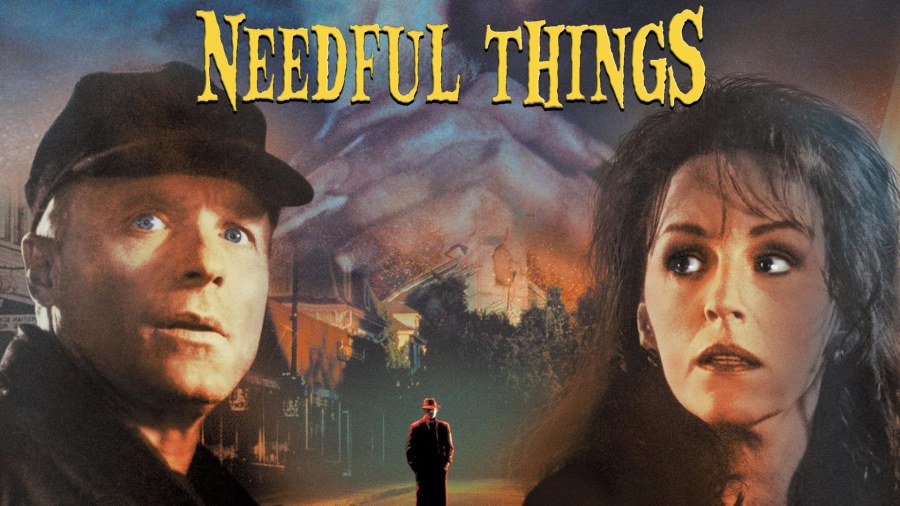
“Needful Things” (1993)
Horror/Drama

Running Time: 102 minutes
Written by: W. D. Richter
Directed by: Fraser C. Heston
Featuring: Ed Harris, Max von Sydow, Bonnie Bedelia, J. T. Walsh and Amanda Plummer
Leland Gaunt: “The young carpenter from Nazareth? I know him well. Promising young man. He died badly.”
Critical Commentary
“Needful Things,” a film adaptation of Stephen King’s novel of the same name, directed by Fraser C. Heston, is a gripping exploration of human nature and the consequences of unchecked desires. Released in 1993, this horror-drama takes audiences on a dark and twisted journey into the seemingly quaint town of Castle Rock. With an ensemble cast led by Max von Sydow and Ed Harris, the movie weaves a complex narrative that delves into the sinister machinations of a mysterious shop owner and the havoc he wreaks on the lives of the townsfolk.
The story unfolds in Castle Rock, a picturesque town that becomes the epicenter of a malevolent force when a peculiar shop named “Needful Things” opens its doors. Leland Gaunt, played masterfully by Max von Sydow, sets up this curio shop, offering a variety of items that fulfill the deepest desires of the residents. However, these seemingly harmless transactions come at a tremendous cost, as the residents unknowingly become pawns in a diabolical game of manipulation and chaos.
The strength of “Needful Things” lies in its character development, with each resident of Castle Rock representing a facet of human desire and vulnerability. Ed Harris, portraying Sheriff Alan Pangborn, delivers a nuanced performance as the moral compass of the town. Pangborn becomes the central figure trying to unravel the mysteries behind the chaos that ensues after the shop’s opening.
On the other hand, Max von Sydow’s portrayal of Leland Gaunt is nothing short of mesmerizing. His charismatic and enigmatic presence dominates every scene, infusing the character with a chilling charm that makes him both repulsive and magnetic. Gaunt manipulates the townsfolk by tapping into their deepest desires and exploiting their weaknesses, turning the idyllic town into a hotbed of resentment and violence.
At its core, “Needful Things” explores the destructive power of unchecked greed and the corrupting influence of desire. The film serves as a cautionary tale, illustrating how the pursuit of personal satisfaction can lead individuals down a path of moral decay and societal collapse. The residents of Castle Rock, once a tight-knit community, succumb to their basest instincts as they vie for the tantalizing offerings of Gaunt’s shop.
The narrative skillfully unfolds the consequences of the characters’ choices, highlighting the ripple effect of their actions on the community. It becomes evident that what initially appears as a series of isolated incidents is, in fact, a carefully orchestrated web of manipulation designed to exploit the inherent flaws of human nature.
Fraser C. Heston’s direction and Tony Westman’s cinematography contribute significantly to the film’s overall atmosphere. The use of dark, muted tones enhances the foreboding sense that something sinister lurks beneath the surface of this seemingly serene town. The juxtaposition of quaint, small-town imagery with the increasingly disturbing events creates a palpable tension that keeps viewers on the edge of their seats.
The setting, a meticulously crafted Castle Rock, becomes a character in itself. The town transforms from an idyllic backdrop to a nightmarish landscape, mirroring the internal turmoil of its inhabitants. The careful attention to detail in the production design underscores the descent of the community into chaos, with Gaunt’s shop at the epicentre of the town’s unravelling.
Patrick Doyle’s haunting musical score complements the film’s eerie atmosphere, enhancing the emotional impact of pivotal scenes. The use of subtle melodies and dissonant tones underscores the psychological horror unfolding onscreen. Doyle’s score becomes an integral part of the storytelling, heightening the suspense and unease that permeate the narrative.
“Needful Things” transcends the horror genre by delving into complex moral themes. As the town succumbs to Gaunt’s manipulations, characters are forced to confront their darkest impulses and grapple with the consequences of their actions. The film raises thought-provoking questions about the nature of good and evil, exploring whether redemption is possible for those who have strayed down a morally dubious path.
Ed Harris’s portrayal of Sheriff Pangborn becomes a focal point for this exploration of morality. Pangborn’s unwavering commitment to justice and morality in the face of overwhelming chaos serves as a beacon of hope in an otherwise bleak narrative. His internal struggle and determination to restore order add depth to the film, elevating it beyond a mere horror flick to a philosophical examination of the human condition.
“Needful Things” benefits from its source material, Stephen King’s novel, which provides a rich and layered narrative for adaptation. The film captures the essence of King’s exploration of small-town dynamics and the fragility of societal norms. While some adaptations struggle to translate the depth of King’s novels to the screen, “Needful Things” succeeds in maintaining the thematic complexity that is a hallmark of the author’s work.
While “Needful Things” is a compelling and atmospheric film, it is not without its flaws. Some critics argue that the intricate web of characters and subplots can be overwhelming, making it challenging for viewers to fully invest in each individual’s story. Additionally, the film’s pacing may be perceived as slow for those expecting a more traditional horror experience. However, the deliberate pacing serves to build suspense and tension, allowing the audience to immerse themselves in the unravelling events.
Beneath the surface-level horror and supernatural elements, “Needful Things” subtly incorporates social commentary and allegory. The town of Castle Rock becomes a microcosm reflecting the societal struggles and conflicts prevalent in the real world. Gaunt’s manipulative tactics symbolize the external forces that exploit people’s vulnerabilities, whether through political, economic, or social means.
The diverse range of characters, each representing different aspects of the human condition, allows the film to explore various societal issues. From the corrosive effects of unchecked capitalism to the destructive power of prejudice and resentment, “Needful Things” serves as a mirror reflecting the darker aspects of human behavior. The narrative invites viewers to reflect on the consequences of their own desires and the potential impact on the communities they inhabit.
Leland Gaunt’s shop, “Needful Things,” is a symbol of temptation and the allure of immediate gratification. The items within the shop act as metaphors for the characters’ deepest desires and insecurities. This symbolism extends beyond the individual level to represent the broader societal pitfalls of succumbing to instant gratification and the pursuit of personal gain at the expense of communal well-being.
The escalating chaos in Castle Rock can be seen as an allegory for the fragility of societal structures when faced with internal strife. As the town tears itself apart, “Needful Things” serves as a cautionary tale about the dangers of prioritizing personal desires over the collective good. The film’s climax, where characters confront the consequences of their actions, reinforces the idea that redemption is possible, but only through acknowledging and rectifying one’s mistakes.
While “Needful Things” may not have achieved the same level of recognition as some other Stephen King adaptations, its impact on the horror genre and cinematic storytelling cannot be overlooked. The film’s exploration of psychological horror and its focus on character-driven narratives have influenced subsequent horror films. The nuanced approach to portraying the supernatural as an external manifestation of internal conflicts sets “Needful Things” apart in the realm of horror cinema.
The film’s legacy also extends to its thematic exploration of morality, echoing the timeless themes found in much of Stephen King’s work. The enduring popularity of King’s novels and their adaptations speaks to the universal appeal of stories that delve into the complexities of human nature, morality, and the thin veneer separating order from chaos.
“Needful Things” remains a cinematic gem that transcends its horror genre roots. Fraser C. Heston’s direction, coupled with the stellar performances of the cast, elevates the film into a thoughtful exploration of the human condition. The narrative complexity, rich character development, and the film’s ability to seamlessly blend horror with social commentary contribute to its enduring appeal.
As a Stephen King adaptation, “Needful Things” successfully captures the essence of the author’s storytelling prowess. It taps into the collective fears and desires that define the human experience, offering more than just jump scares and supernatural thrills. The film challenges viewers to reflect on their own moral compass, the consequences of their actions, and the delicate balance between individual desires and societal well-being.
“Needful Things” stands as a testament to the enduring power of horror as a genre capable of not only inducing fear but also provoking introspection. Its exploration of the sinister allure of unchecked desires continues to resonate with audiences, making it a noteworthy entry in the extensive catalogue of Stephen King adaptations and a film that merits revisiting for both horror enthusiasts and those seeking a thought-provoking cinematic experience.
“Needful Things” stands as a captivating exploration of the human psyche, wrapped in the trappings of a supernatural horror tale. The film’s success lies in its ability to balance the macabre with a thought-provoking exploration of morality, desire, and the consequences of unchecked ambition. The stellar performances, atmospheric cinematography, and evocative musical score contribute to the film’s enduring appeal.
As a cinematic adaptation of Stephen King’s novel, “Needful Things” holds its own, capturing the essence of the author’s intricate storytelling and thematic depth. It remains a testament to the enduring power of King’s work and a chilling reminder of the dangers that lurk when humanity succumbs to its darkest desires. In the pantheon of Stephen King adaptations, “Needful Things” stands as a dark and compelling gem that continues to haunt the collective imagination of horror enthusiasts.
Technical Commentary
Video
“Needful Things” was shot by Tony Westman, who would team again with director Fraser on the feature film “Alaska”, but whose principal work has been in television (he shot most of the Showtime series “Dead Like Me”). Perhaps because director Heston knew in advance that the editing would involve a complex interweaving of multiple threads, he and Westman seem to have opted for a visual style that is relatively low-key, with the exception of the “visions” that Gaunt’s customers experience when each one first encounters his or her “needful thing”.
Audio
The film’s original Dolby Stereo track has been encoded in lossless DTS-HD MA 2.0, and it is very effective when played back through a good surround decoder. Especially notable are the moments when each of Gaunt’s victims comes in contact with his or her “needful thing” and experiences a powerful vision, usually of something deeply fulfilling that renders the victim powerless to resist the object’s allure.


 spryfilm.com