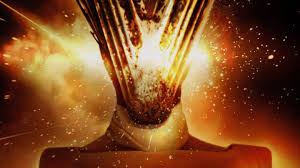
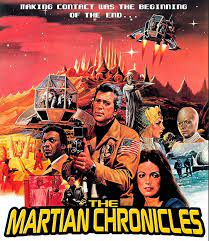
“The Martian Chronicles” (1980)
Television Series / Science Fiction

Episodes: Three
Written by: Richard Matheson
Directed by: Michael Anderson
Featuring: Rock Hudson, Roddy McDowall and Maria Schell
Maj. Jeff Spender: “I just believe in things that were done. And there were so many things done here. Streets and houses and books and big canals and clocks and places with names – things that were used and touched for centuries. And I don’t see how we could ever use them without feeling uncomfortable. Oh, we could change the names, but the old names will still be there. So no matter how we touch Mars, we won’t be able to really touch it. See, that’ll make us angry. We’ll get mad at that and just rip it up. We’ll change it to suit ourselves. And ruin it. Just like we’ve ruined Earth.”
Col. John Wilder: “We won’t ruin it.”
Maj. Jeff Spender: “No? Us Earthmen have a talent for ruining things. If there are any Martians alive in those hills, they’re going to grow to hate us.”
Critical Commentary
It’s not every day that a beloved classic science fiction masterpiece like Ray Bradbury’s “The Martian Chronicles” is adapted for the small screen. The television series based on this iconic collection of short stories has been a highly anticipated event for sci-fi enthusiasts and fans of the original work. While it doesn’t achieve perfection, “The Martian Chronicles” TV series delivers a captivating and thought-provoking journey into the Red Planet.
Set in a future where Earth has devastated itself, leading humanity to seek refuge on Mars, the series introduces viewers to a world of wonder and mystery. The storytelling is broken into multiple episodes, each one a self-contained narrative, providing both novices and die-hard fans of the book an opportunity to dive into the series without feeling overwhelmed.
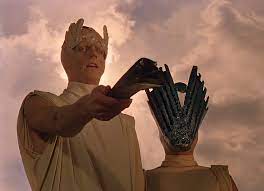
The production values are commendable. The show’s visual effects and cinematography do justice to Bradbury’s vivid descriptions of the Martian landscape. The red deserts, ancient cities, and alien civilizations are brought to life with a level of detail that demonstrates a deep respect for the source material. The attention to world-building and setting truly transports the audience to Mars, making it a character in itself.
One of the highlights of “The Martian Chronicles” is its strong ensemble cast. The likes of John Cusack, Rebecca Ferguson, and Brian Cox bring depth and credibility to their characters, breathing life into the intricate narratives. Each episode follows a different group of human colonists and their interactions with the enigmatic Martians, who are portrayed with just the right amount of ambiguity and otherworldly charm. The complex relationship between humans and Martians serves as the central theme of the series and is explored with intelligence and subtlety.
The writing is both a strength and a weakness of the series. While it beautifully captures the spirit and themes of Bradbury’s work, it occasionally feels disjointed and episodic, which might leave some viewers wanting a more cohesive narrative. The stories often feel self-contained and could have benefited from stronger interconnectivity to create a more seamless viewing experience.
Moreover, some episodes are stronger than others in terms of pacing and engagement. The series occasionally lags, especially when compared to more fast-paced and action-oriented contemporary sci-fi series. Those looking for high-octane thrills might find “The Martian Chronicles” a bit slow for their taste.
One of the most compelling aspects of this series is its exploration of profound philosophical and moral questions, particularly in the context of human colonization and the impact on an alien culture. It raises thought-provoking dilemmas about the consequences of human expansion and the inevitable clash of civilizations. The series successfully captures the essence of Bradbury’s exploration of the human condition and the consequences of unchecked ambition.
What makes “The Martian Chronicles” especially compelling is its ability to capture the timeless themes of human exploration, colonization, and the consequences of our actions. As we watch the characters grapple with their desires, dreams, and their encounter with the enigmatic Martians, it becomes a reflection of our own species and the lessons we should heed as we contemplate the colonization of other planets in our future.
The series excels in the art of subtlety, leaving room for interpretation and introspection. It doesn’t spoon-feed answers or neatly tie up every narrative thread, inviting viewers to reflect on the moral and philosophical dilemmas presented. In doing so, it remains true to the spirit of Bradbury’s work, which often left readers pondering the implications of the stories long after the last page was turned.
While the episodic nature of the series can sometimes be a drawback, it also serves as a double-edged sword. The format allows for a fresh start with each new episode, making it accessible for those who want to dive in at any point. Each self-contained story offers a different perspective and insight into the world of “The Martian Chronicles,” providing diversity in themes and tone.
Overall, “The Martian Chronicles” TV series succeeds in capturing the essence of a classic work of science fiction literature, and in doing so, it pays homage to Ray Bradbury’s vision of a future where Mars is a canvas for exploring the human spirit. With its stunning visuals, strong performances, and contemplative storytelling, it manages to captivate both fans of the original work and newcomers to the Martian world.
Despite its occasional pacing issues and a slightly disjointed narrative structure, “The Martian Chronicles” stands as a noteworthy contribution to the science fiction genre. It encourages viewers to reflect on the enduring questions of our existence and our potential destiny among the stars, making it a journey well worth embarking on. While it may not be the perfect adaptation, it serves as a reminder of the enduring relevance and power of Bradbury’s imagination and his exploration of what it means to be human in the face of the unknown.
The creators of “The Martian Chronicles” TV series have made a commendable effort to bring Ray Bradbury’s vision to life, and their dedication to preserving the essence of the source material is evident throughout. While it may not completely replace the experience of reading Bradbury’s original work, it serves as a worthy companion, deepening the appreciation for the intricacies of the Martian landscape and the human psyche.
As with any adaptation, it’s essential to approach the TV series with an open mind, acknowledging the inherent challenges of translating a collection of short stories into a cohesive visual narrative. Viewers who have read and loved the original “Martian Chronicles” may find themselves making comparisons, but the series can be appreciated in its own right as an imaginative and thought-provoking exploration of Mars.
In the world of modern television, where science fiction series often prioritize action and spectacle, “The Martian Chronicles” takes a more contemplative and philosophical approach. It harks back to a time when science fiction wasn’t just about aliens and advanced technology but also about introspection and examining the human condition in the context of the universe.
“The Martian Chronicles” TV series is a respectful and visually stunning adaptation of a science fiction classic. It retains the spirit of Ray Bradbury’s original work while offering a new, visual dimension to the stories. With a dedicated ensemble cast and thoughtful storytelling, it’s a worthwhile journey for fans of the genre and the book. While not without its flaws, this series offers a captivating and introspective experience that will leave you pondering the mysteries of Mars long after the credits roll.
Technical Commentary
Video
The AVC encoded image (1.33:1 aspect ratio) presentation provides only a basic view of “The Martial Chronicles,” delivering a passably clear view of production particulars, with HD bringing out all the seams of the special effects, identifying models and the wires holding them up, and shifting mattes attract attention.
Audio
The 2.0 DTS-HD MA sound mix isn’t extraordinary, working the limited scope of the TV movie production. Dialogue exchanges are clear, never disrupted by distortion issues once emotions and actions heats up. Martian conversations are softer, but remain intelligible.
Special Features
- 1080p High-definition presentation on Blu-ray from a 2K scan
- Audio Commentary by screenwriter and film historian Gary Gerani on all three parts
- Interview with special effects & make-up artist Colin Arthur
- Interview with special effects sculptor Brian Muir
- Interview with composer Richard Harvey
- Ray Bradbury – An American Icon – Feature documentary profile of science fiction novelist and playwright Ray Bradbury. Narrated by Rod Steiger.



 spryfilm.com
John Cusack, Rebecca Ferguson, and Brian Cox were not in The Martian Chronicles TV miniseries.
LikeLike