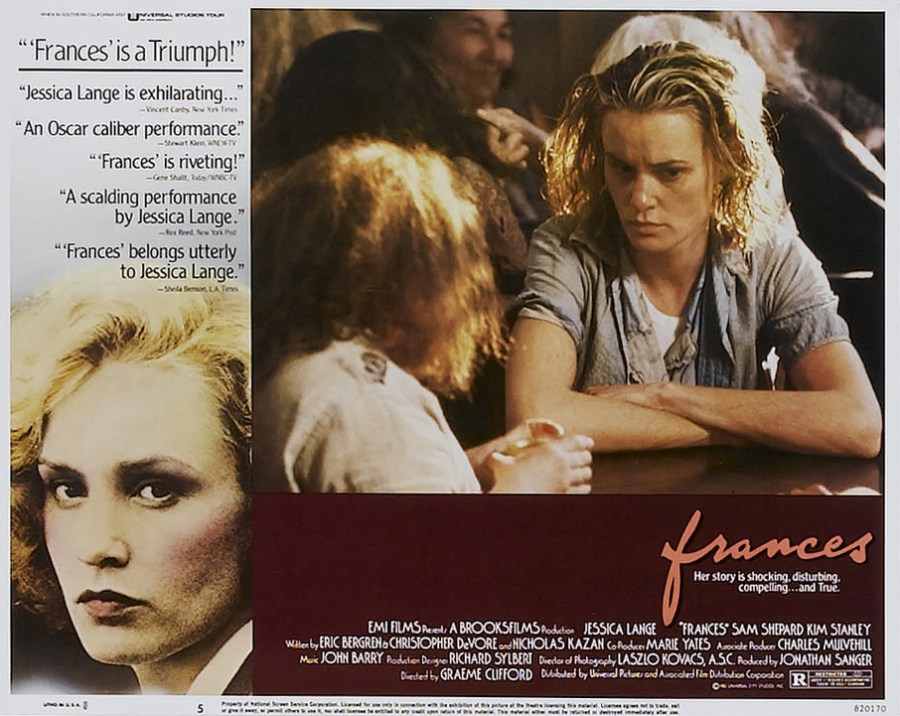
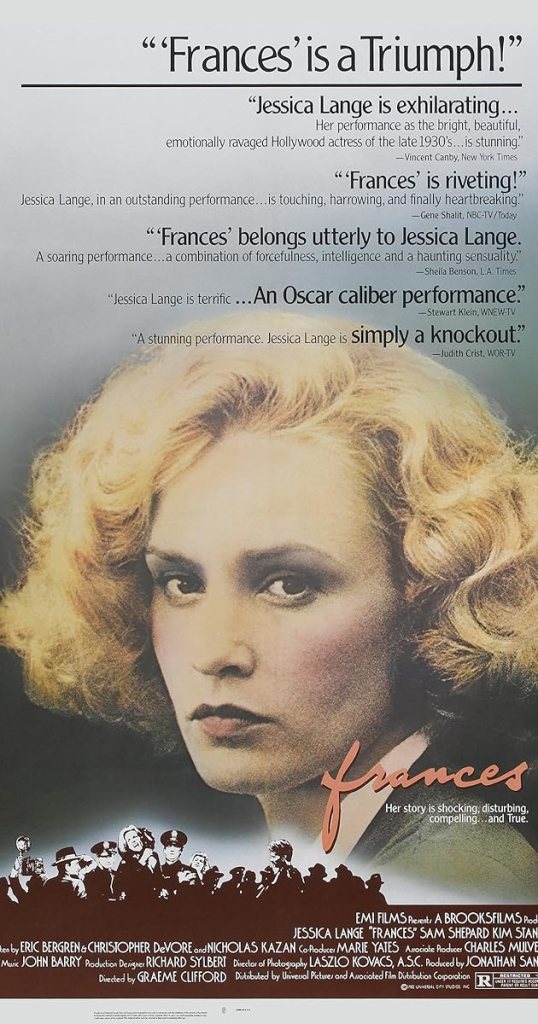
“Frances” (1982)
Drama

Running Time: 140 minutes
Written by: Eric Bergren, Christopher De Vore and Nicholas Kazan
Directed by: Graeme Clifford
Featuring: Jessica Lange, Sam Shepard and Kim Stanley
Harry York: “Frances, you’re crazy.”
Frances Farmer: [softly] “Don’t tell anybody.”
Critical Commentary
In the realm of cinema, there are certain films that transcend the boundaries of time, leaving an indelible mark on the audience’s heart and mind. “Frances,” directed by Graeme Clifford in 1982, is one such cinematic gem that has earned its rightful place among the classics. This biographical drama offers a compelling glimpse into the tumultuous life of actress Frances Farmer, portrayed with extraordinary depth and nuance by Jessica Lange. In this 2000-word review, we will explore the multifaceted aspects of “Frances,” from its exceptional performances and evocative storytelling to its historical significance and enduring relevance.
“Frances” is a biographical drama that chronicles the life of Frances Farmer, an actress from the 1930s whose story is both tragic and fascinating. The film opens with Frances’ early life in Seattle, where her rebellious spirit and artistic aspirations begin to take shape. She dreams of becoming a successful actress but faces numerous challenges, both personal and societal, as she tries to break into the entertainment industry. Frances’ journey is marked by her unconventional behavior, struggles with mental health, and conflicts with her overbearing mother, Lillian Farmer, played convincingly by Kim Stanley.
The film meticulously traces Frances’ evolution from a young, ambitious woman to a Hollywood starlet, and ultimately, her descent into a world of mental illness and institutionalization. The narrative is both heartbreaking and thought-provoking, as it explores the sacrifices one must make for artistic success and the toll it can take on one’s mental well-being.
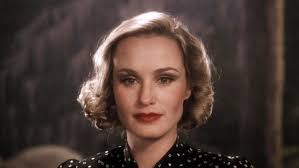
“Frances” is undoubtedly a character-driven film, and its success hinges on the performance of its lead actress, Jessica Lange. In what can only be described as a tour de force, Lange delivers a mesmerizing portrayal of Frances Farmer. Her performance is a masterclass in acting, showcasing her ability to embody the complexities and contradictions of this enigmatic character.
Lange skillfully navigates Frances’ transformation from a fiery, independent young woman to a vulnerable and tormented soul. Her emotional range is nothing short of astounding, as she portrays Frances with both grace and raw intensity. Whether it’s Frances’ moments of defiance, vulnerability, or despair, Lange brings an authenticity to the character that is truly remarkable. It’s a performance that leaves an indelible mark and earned Lange an Academy Award nomination, firmly establishing her as a powerhouse in Hollywood.
Graeme Clifford’s direction in “Frances” is commendable, as he manages to capture the essence of the era in which the story unfolds while maintaining a timeless quality. The film’s cinematography, led by cinematographer László Kovács, is both evocative and visually stunning. The use of color, lighting, and framing contributes to the film’s overall atmosphere, effectively conveying the mood and emotions of the characters.
The period-accurate production design and costume choices add authenticity to the film, immersing the audience in the world of 1930s and 1940s Hollywood. The attention to detail in recreating this era is a testament to the dedication of the production team and their commitment to transporting viewers back in time.
One of the most compelling aspects of “Frances” is the complex and tumultuous relationship between Frances and her mother, Lillian. Kim Stanley’s performance as Lillian is equally impressive, portraying a woman who is both a source of love and suffocating control in Frances’ life. The film delves into the deep-seated conflicts between mother and daughter, revealing the suffocating grip of maternal expectations on Frances’ aspirations.
The depiction of this relationship adds depth to the narrative and offers a glimpse into the psychological underpinnings of Frances’ struggles. It explores the age-old theme of the artist’s conflict with society and family, where pursuing one’s artistic dreams often clashes with societal norms and familial expectations. The tension between Frances and Lillian is a central driving force in the film, making it as much a family drama as a biographical one.
“Frances” raises thought-provoking questions about the price of autonomy and individualism. Frances Farmer’s story is one of a woman who refused to conform to the expectations of her time, both as a daughter and an actress. Her desire for autonomy and artistic freedom clashed with the rigid norms and regulations of Hollywood and society in the 1930s and 1940s.
As Frances grapples with the pressures of fame, mental illness, and societal expectations, the film forces the audience to confront the broader themes of conformity, gender roles, and the sacrifices required to pursue one’s passions. It serves as a reminder of the enduring struggle many artists face when trying to navigate the fine line between self-expression and societal acceptance.
“Frances” also provides a sobering exploration of the darker aspects of fame and the entertainment industry. As Frances ascends to stardom, she becomes a target for the media, with her every move scrutinized and sensationalized. The film highlights how fame can be a double-edged sword, offering adulation and success on one hand while eroding one’s privacy and mental stability on the other.
Frances’ experiences with the mental health care system of her time also shed light on the inadequacies and mistreatment that individuals faced in mental institutions during that era. Her institutionalization and forced medical treatments serve as a stark reminder of the challenges faced by those with mental health issues in a society that often stigmatized and misunderstood them.
Mental health is a central theme in “Frances,” and the film is unflinching in its portrayal of Frances’ struggles with mental illness. It offers a nuanced depiction of her journey, showcasing her moments of lucidity, as well as her periods of instability. The film raises important questions about the treatment of mental illness in the 1930s and 1940s and the societal attitudes toward those who suffered from it.
While the film provides a compassionate portrayal of Frances’ mental health challenges, it also serves as a commentary on the need for greater understanding and support for individuals facing similar issues today. In this regard, “Frances” remains relevant in a contemporary context, as discussions around mental health continue to evolve and gain prominence in society.
“Frances” was not a commercial success upon its initial release, but it has since gained a cult following and is considered a classic of American cinema. Its enduring legacy lies in its ability to resonate with audiences across generations. The film’s exploration of themes such as individualism, mental health, and the price of fame continues to be relevant and thought-provoking.
Furthermore, Jessica Lange’s performance in “Frances” is often cited as one of the standout performances in her illustrious career. The film marked a turning point in her acting trajectory, establishing her as a talent to be reckoned with, and she went on to become one of Hollywood’s most celebrated actresses.
“Frances” (1982) is a cinematic masterpiece that offers a compelling and poignant portrayal of the life and struggles of actress Frances Farmer. The film
Technical Commentary
Video
“Frances” is presented on Blu-ray with an AVC encoded 1080p transfer in 1.85:1. In its best moments, things are agreeable and detail levels are very good, but there are a number of deficiencies, including some chroma anomalies on grain.
Audio
The disc offers two Spanish language options, one without subtitles and the other with.
Special Features
- 1080P High-definition presentation on Blu-ray from a 2K scan
- Audio Commentary from film historian & critic Matthew Asprey Gear (2023)
- Audio Commentary by director Graeme Clifford and David Gregory
- Reflecting on ‘Frances’ – Interview with producer Jonathan Sanger (2023)
- Goodnight, ‘Frances’ – Interview with director Graeme Clifford (2023)
- Deco Dreams: The Art and Syle of ‘Frances’ – Interview with art director Ida Random (2023)
- A Hollywood Life: Remembering ‘Frances’ – featurette
- Archival interview with Jessica Lange (1983)
- Theatrical Trailer
 spryfilm.com