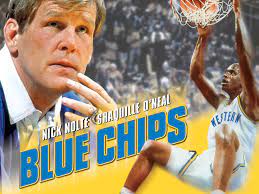
“Blue Chips” (1994)
Drama

Running Time: 108 minutes
Written by: Ron Shelton
Directed by: William Friedkin
Featuring: Nick Nolte, Mary McDonnell, Ed O’Neill, J. T. Walsh, Alfre Woodard and Shaquille O’Neal
Pete Bell: “Dwayne, you can get through college half-assed. Richard, you can get through LIFE half-assed. But I’ll guarantee you boys one thing: sure as hell, I’ll guarantee you this: you cannot win half-assed!”
Critical Commentary
“Blue Chips” is a 1994 sports drama film directed by William Friedkin and written by Ron Shelton. The movie is a gripping exploration of the world of college basketball, shedding light on the ethical dilemmas and intense pressures faced by athletes, coaches, and institutions involved in the game. Starring Nick Nolte, Shaquille O’Neal, and Anfernee “Penny” Hardaway, “Blue Chips” delves into issues such as recruiting violations, the corrupting influence of money in college sports, and the sacrifices made in the relentless pursuit of excellence.
In this analysis, we will dissect the film “Blue Chips,” examining its portrayal of the world of college basketball, the moral dilemmas faced by its characters, and the broader implications of the issues it raises.
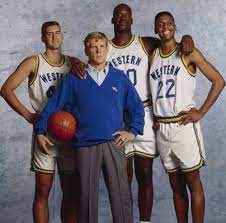
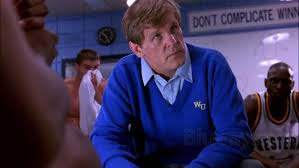
“Blue Chips” revolves around the life of Pete Bell (played by Nick Nolte), a renowned college basketball coach facing tremendous pressure to maintain his team’s success. His team, the Western University Dolphins, has been a perennial contender for the NCAA championship, but Pete is feeling the heat to keep winning, which leads him down a morally ambiguous path. Pete’s world collides with the harsh realities of college basketball recruiting, where under-the-table payments, promises of luxury cars, and other enticements are used to lure top high school players. He is introduced to boosters like Happy (played by J.T. Walsh), who represent the dark underbelly of college sports, using their wealth to secure recruits for their alma mater. As Pete grapples with his own ethical principles, he faces immense temptation as he tries to secure the talents of a blue-chip recruit, Neon Boudeaux (played by Shaquille O’Neal), who is an incredibly talented but academically challenged athlete. In the midst of this ethical turmoil, Pete also recruits Ricky Roe (played by Matt Nover), who is persuaded with a new car, despite his own initial reluctance. Pete’s struggle comes to a head when he contemplates paying the talented high school player Butch McRae’s father to ensure his commitment to Western University. However, McRae’s father declines the offer, emphasizing the importance of his son’s education over material wealth.
The film also introduces us to another high school basketball star, Penny Hardaway (played by Anfernee “Penny” Hardaway), who initially refuses Pete’s offers due to the corrupt system but ultimately chooses to play for Western University, putting his family’s financial needs above ethical concerns.
“Blue Chips” unearths the murky world of college basketball recruiting, where talented young athletes are often lured with promises of riches, cars, and other incentives. The film highlights the ethical quandaries faced by coaches like Pete Bell, who must navigate this treacherous terrain to stay competitive. This theme reflects real-life scandals that have plagued college sports for decades, exposing the conflicts between athletic success and ethical conduct.
Pete Bell serves as the moral compass of the film. His internal struggle is emblematic of the moral dilemmas faced by coaches and institutions in the pursuit of athletic glory. The film questions whether success can ever justify compromising one’s principles. Pete grapples with these questions as he is tempted to make illegal payments to secure top recruits, mirroring the ethical challenges many in the industry face.
“Blue Chips” explores the immense pressures placed on coaches and players in college sports. The sacrifices made by athletes, their families, and coaches are depicted vividly. For players like Neon Boudeaux and Ricky Roe, the promise of financial rewards can outweigh ethical concerns, highlighting the vulnerability of young athletes in the system.
The film underscores the tension between education and athletic talent. McRae’s father’s refusal to accept payment for his son’s commitment to a university emphasizes the importance of academics. In contrast, Penny Hardaway’s decision to join Western University due to his family’s financial needs raises questions about the exploitation of student-athletes and their families.
“Blue Chips” sheds light on the role of boosters, wealthy alumni who often exert undue influence on college athletic programs. Happy, the booster character in the film, represents the corrupting influence of money in college sports, where the pursuit of success can lead to morally compromising situations.
The film portrays coaches not as infallible heroes but as individuals grappling with their own flaws and vulnerabilities. Pete Bell’s character, in particular, is multifaceted, highlighting the complexity of his decisions and the toll that the high-stakes world of college basketball takes on him.
“Blue Chips” remains relevant today as it continues to be cited in discussions about the ethics of college sports. It serves as a cautionary tale, reminding us of the ethical pitfalls that coaches, players, and institutions can face when the pursuit of athletic excellence overshadows principles.
In the years following the film’s release, the NCAA implemented various reforms aimed at addressing recruiting violations, including stricter rules on financial incentives and benefits for student-athletes. While these reforms have made strides in cleaning up college sports, the fundamental challenges and ethical dilemmas explored in “Blue Chips” persist.
The film also contributed to the conversation around the exploitation of student-athletes. The ongoing debate over whether college athletes should be compensated for their talents, as well as recent legislative changes allowing student-athletes to profit from their likeness, highlights the enduring relevance of the issues raised in “Blue Chips.”
Over the years, “Blue Chips” has achieved cult status in the realm of sports films. It’s often referenced and quoted by sports enthusiasts, particularly in discussions about the moral complexities of college athletics. The film’s portrayal of the dark side of recruiting and the pressures faced by coaches and players has left a lasting impression on audiences. It’s not uncommon to hear phrases like “I got a couple of tractor-trailers full of cash!” or “My ass is on the line!” in the context of college basketball discussions, highlighting the film’s memorable lines and characters.
Furthermore, the casting of real-life basketball stars, including Shaquille O’Neal and Anfernee “Penny” Hardaway, added authenticity to the film. Their presence served to underscore the blurred lines between fiction and reality in the world of college basketball recruiting.
While “Blue Chips” was released in 1994, its themes and ethical dilemmas remain highly relevant in today’s sports landscape. The controversies surrounding college sports have not disappeared; if anything, they have become more pronounced. Issues such as the “pay-for-play” debate, the exploitation of student-athletes, and recruiting scandals continue to make headlines.
One notable development since the film’s release is the introduction of the NCAA’s Name, Image, and Likeness (NIL) rules, which allow student-athletes to profit from their personal brands. This represents a significant shift in the college sports landscape and addresses some of the inequities and ethical concerns raised in “Blue Chips.”
However, the film’s fundamental questions about the role of money, ethics, and education in college sports remain largely unresolved. The allure of financial incentives, the pressure to win at all costs, and the challenges faced by young athletes and their families persist.
“Blue Chips” is more than just a sports movie; it is a thought-provoking exploration of the ethical dilemmas and pressures faced by those involved in college basketball. Through its compelling characters and gripping storyline, the film forces viewers to confront the moral complexities of the world of college athletics.
As we reflect on “Blue Chips” nearly three decades after its release, we are reminded of the enduring issues it raises in the world of college sports. The film continues to be a touchstone in discussions about the corrupting influence of money, the sacrifices made in the pursuit of athletic excellence, and the ethical choices faced by coaches, players, and institutions. Ultimately, “Blue Chips” challenges us to consider where we draw the line between competition and integrity in the world of college sports, a question that remains as relevant today as it was when the film first hit the screens in 1994.
Technical Commentary
Video
Presented in an aspect ratio of 1.78:1, encoded with MPEG-4 AVC and granted a 1080p transfer, Blue Chips arrives on Blu-ray courtesy of Via Vision Entertainment. The release is sourced from an older but very solid master that was supplied by Paramount Pictures. In case you are wondering whether it is the same master that was used for the U.S. release of Blue Chips, the answer is yes, it is. Delineation, clarity, and depth are very pleasing throughout the entire film. There are only a few spots where slightly bigger than usual fluctuations reveal flatness that is usually associated with weaker older masters.
Audio
There are two standard audio tracks on this Blu-ray release: English LPCM 2.0 and English DTS-HD Master Audio 5.1. Optional English SDH subtitles are provided for the main feature.
Special Features
- “Finding Your Way” – in this exclusive new program, editor Robert K. Lambert discusses the early stages of his career, his approach to editing and composition, relationship with William Friedkin and work on Blue Chips. There are some particularly interesting observations about the editing of Sorcerer as well. In English, not subtitled. (14 min).
- “Painting Blue” – in this exclusive new program, director of photography Tom Priestly Jr. explains how he fell in love with filmmaking and how his career evolved over the years, and discusses his work with William Friedkin on Blue Chips. Also, there are plenty of interesting observations about the making of The Exorcist and The French Connection and the importance of proper lighting. In English, not subtitled. (16 min).
- “We Don’t Buy Athletes: Illegal Recruiting and the NCAA” – in this exclusive new program, sports journalist Ben Strauss discusses the politics and business interests that have infiltrated college basketball in America. In English, not subtitled. (9 min).
- Commentary – in this exclusive new audio commentary, critic Bilge Ebiri discusses the production of Blue Chipsand the many ways in which the film recreates real personalities, practices, and even business interests that define college basketball in America.
- Trailer – a vintage trailer for Blue Chips. In English, not subtitled. (3 min).



 spryfilm.com