
“Reservoir Dogs” (1992)
Action

Running Time: 104 minutes
Written and directed by: Quentin Tarantino
Featuring: Harvey Keitel, Tim Roth, Chris Penn, Steve Buscemi, Lawrence Tierney and Michael Madsen
Mr. Blonde: “Hey Joe, you want me to shoot this guy?”
Mr. White: [laughs] “Shit… You shoot me in a dream, you better wake up and apologize.”
Critical Commentary
In 1992, a then-unknown filmmaker named Quentin Tarantino burst onto the scene with his directorial debut, “Reservoir Dogs.” With its non-linear storytelling, distinctive dialogue, and intense violence, the film quickly became a cult classic and established Tarantino as a force to be reckoned with in the world of cinema. “Reservoir Dogs” not only showcased Tarantino’s unique style but also set the stage for a new era of independent filmmaking.
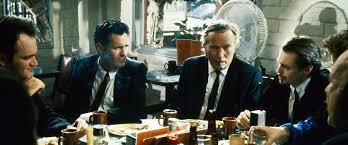
“Reservoir Dogs” centers around a botched diamond heist orchestrated by a group of criminals who don’t know each other’s real names, only their assigned color-coded aliases. The film opens with a diner scene in which the characters banter about pop culture, setting the tone for the snappy and distinctive dialogue that would become a trademark of Tarantino’s work.
The film’s non-linear narrative structure, a technique for which Tarantino would become renowned, is immediately apparent as the story unfolds through a series of interconnected flashbacks and present-day scenes. This structure adds a layer of complexity to the storytelling, forcing the audience to piece together the events and motivations that led to the disastrous heist. This narrative approach also serves to intensify suspense and tension, creating a sense of uncertainty and unease.
Each character’s backstory is revealed through these nonlinear sequences, shedding light on their motivations and personalities. Mr. White (Harvey Keitel), Mr. Blonde (Michael Madsen), Mr. Pink (Steve Buscemi), and the rest of the color-coded criminals come to life through their interactions and monologues, showcasing Tarantino’s knack for creating memorable and multi-dimensional characters.
One of the most distinctive aspects of “Reservoir Dogs” is its dialogue. Tarantino’s script is peppered with profanity, pop culture references, and sharp wit, creating a unique rhythm that is as entertaining as it is unforgettable. The infamous “ear scene,” in which Mr. Blonde tortures a captured police officer while dancing to “Stuck in the Middle with You” by Stealers Wheel, juxtaposes extreme violence with casual conversation, exemplifying Tarantino’s ability to blend the mundane with the macabre.
The characters’ banter ranges from discussions about Madonna’s “Like a Virgin” to debates about tipping in restaurants. These seemingly inconsequential conversations serve to humanize the criminals, making them relatable and oddly sympathetic despite their heinous actions. The film’s dialogue-driven moments are not just filler; they provide insight into the characters’ psyches and motivations.
“Reservoir Dogs” is notorious for its graphic violence, a hallmark of Tarantino’s filmmaking style. However, the violence in the film serves a purpose beyond shock value. It underscores the brutality of the criminal world and tests the characters’ loyalty and morality. The juxtaposition of extreme violence with mundane settings and conversations creates a sense of dissonance that lingers in the minds of the audience.
The film’s cinematography and visual aesthetics are equally impactful. The choice to depict the heist itself off-screen allows the audience to focus on the aftermath and the characters’ reactions. The use of slow-motion during pivotal moments, such as the Mexican standoff near the film’s climax, heightens tension and draws attention to the significance of these moments.
“Reservoir Dogs” had a profound impact on the landscape of independent cinema. With its limited budget, Tarantino demonstrated that a compelling story, strong characters, and innovative filmmaking techniques could captivate audiences without the need for massive Hollywood resources. The film’s success paved the way for other independent filmmakers to experiment with unconventional storytelling and to prioritize character development over spectacle.
Tarantino’s use of an eclectic soundtrack, incorporating songs from various genres and eras, also became a hallmark of his work. The soundtrack of “Reservoir Dogs” not only enhances the film’s atmosphere but also demonstrates Tarantino’s deep appreciation for music as a storytelling tool.
The film’s critical acclaim and cult following propelled Tarantino into the spotlight, setting the stage for his subsequent successes, including “Pulp Fiction,” “Kill Bill,” and “Django Unchained.” Tarantino’s signature style, characterized by its blend of violence, pop culture references, nonlinear narratives, and unforgettable dialogue, can be traced back to the foundations established in “Reservoir Dogs.”
“Reservoir Dogs” marked a turning point in how audiences perceived crime films. Before its release, crime films often followed a formulaic structure with clear-cut heroes and villains. However, Tarantino’s approach blurred these lines, making it difficult to categorize characters as simply good or bad. This moral ambiguity added depth to the story and challenged viewers to engage with complex characters who grappled with their own choices and motivations.
The film’s impact on popular culture is evident in the countless references and homages it has inspired in subsequent films, television shows, and even other forms of media. The concept of color-coded aliases for criminals, as seen in “Reservoir Dogs,” has become a recognizable trope in various genres. Moreover, the use of nonlinear storytelling has been adopted by many filmmakers seeking to add depth and intrigue to their narratives.
“Reservoir Dogs” is a showcase of stellar performances from its ensemble cast. Harvey Keitel’s portrayal of Mr. White is a standout, capturing the character’s complex mix of loyalty, compassion, and ruthlessness. Michael Madsen’s Mr. Blonde exudes a chilling charisma that makes his violent outbursts all the more unsettling. Steve Buscemi’s fast-talking Mr. Pink brings a touch of dark comedy to the film, and Tim Roth’s Mr. Orange expertly navigates the character’s internal struggle as an undercover cop.
The interactions between these characters reveal their vulnerabilities and insecurities, making them feel like real individuals rather than mere caricatures. Tarantino’s script and the actors’ performances work in harmony to create a sense of camaraderie and tension among the criminals, all while exploring their diverse personalities.
At its core, “Reservoir Dogs” delves into themes of betrayal and trust. The plot revolves around a mole within the group, which ultimately leads to the disastrous outcome of the heist. The film explores how loyalty can be tested and manipulated under pressure, and how trust can be a fragile commodity in a criminal underworld where self-preservation often takes precedence.
This exploration of human nature in extreme circumstances resonates with audiences on a deeper level. The characters’ struggles with trust and betrayal mirror universal human experiences, allowing viewers to connect with the story and its themes on a personal level.
Over the years, “Reservoir Dogs” has continued to gain new generations of fans who appreciate its unconventional storytelling, unique characters, and bold visual style. It remains a film that sparks discussions and debates about its meaning, symbolism, and underlying messages. The film’s enduring popularity has solidified its place in cinema history, making it a staple in discussions about influential and ground-breaking movies.
As Tarantino’s directorial debut, “Reservoir Dogs” set the stage for his subsequent films, each of which would carry his distinctive style and narrative techniques. The film’s success not only launched Tarantino’s career but also had a broader impact on the filmmaking industry. It highlighted the potential of independent cinema to challenge conventions and captivate audiences, inspiring filmmakers to experiment with storytelling, characterization, and visual aesthetics.
“Reservoir Dogs” is a film rich in thematic depth and symbolism, offering viewers an opportunity to delve deeper into its narrative and characters. One prominent theme explored in the movie is the concept of identity and how it can be concealed or manipulated. The characters in the film go by color-coded aliases, highlighting the idea that in the criminal world, one’s true identity is often obscured. This theme of identity ties into the characters’ struggles with trust and betrayal, as they must navigate a world where everyone wears a mask.
Another theme that resonates throughout the film is the notion of morality in a morally ambiguous world. The characters are criminals, engaging in violent and illegal activities, yet they exhibit moments of empathy, loyalty, and even remorse. The audience is forced to confront their own moral judgments and question whether these characters are entirely devoid of humanity or simply products of their circumstances.
The film’s setting, primarily taking place in a warehouse, serves as a microcosm for the larger criminal underworld. The sterile, nondescript environment is a reflection of the cold and impersonal nature of the criminal operations. The warehouse becomes a pressure cooker, intensifying the characters’ interactions and amplifying the tension as the true identity of the traitor remains a mystery.
“Reservoir Dogs” was met with a mixture of acclaim and controversy upon its release. Critics praised Tarantino’s fresh and audacious approach to filmmaking, acknowledging the film’s impact on the crime genre and its contribution to independent cinema. However, the film’s graphic violence and language sparked debates about its appropriateness and the potential influence on real-world behaviour.
From an academic perspective, “Reservoir Dogs” has been widely studied and analyzed in film schools and scholarly circles. Its narrative structure, dialogue, and use of violence have been dissected as examples of Tarantino’s unique cinematic style. The film’s exploration of themes such as trust, loyalty, and identity has prompted discussions on how these concepts are presented and challenged within the context of the crime genre.
The impact of “Reservoir Dogs” extends beyond its initial release, as it continues to shape filmmaking and pop culture. Quentin Tarantino’s distinct directorial style, which includes nonlinear storytelling, dialogue-driven scenes, and eclectic soundtracks, has become a hallmark of his work and an inspiration for many filmmakers who aim to create original and engaging narratives.
The film’s cultural impact is evident in the numerous references and homages found in subsequent movies, television shows, and even music videos. Elements like the use of aliases, memorable quotes, and the integration of music have become recognizable trademarks that pay tribute to “Reservoir Dogs.”
As the years have passed, “Reservoir Dogs” remains an enduring cinematic work that continues to captivate and engage audiences. Its exploration of complex characters, themes, and storytelling techniques has solidified its status as a classic that transcends time and genre. Quentin Tarantino’s debut film has left an indelible mark on the world of cinema, inspiring filmmakers to push creative boundaries and challenge established norms.
In the grand tapestry of cinema history, “Reservoir Dogs” holds a special place as the catalyst for a new era of filmmaking. Its influence can be seen not only in the subsequent works of Quentin Tarantino but also in the broader landscape of independent cinema. With its unforgettable characters, innovative narrative structure, and thought-provoking themes, “Reservoir Dogs” will undoubtedly continue to be studied, celebrated, and cherished for generations to come.
Technical Commentary
Video
“Reservoir Dogs” comes with a brand new 2160p UHD 4K transfer with Dolby Vision. This is the first time this timeless film has been released in the 4K format. This new UHD image looks fantastic while keeping its very filmic roots. There is no way this film has the digital car-washed-out look, which would make Tarantino lose his mind. The film grain is very much intact and heavy at times, which was the intended purpose and even the early source of this 1992 film. The colour palette is warm, just like Tarantino intended. The browns, oranges, yellows, ambers, and somewhat warmer beige and grey walls look fantastic. The Dolby Vision enhancement makes those gushes of red blood really pop when they pour from orifices and stain the white button-down shirts.
Audio
This release comes with a very good Dolby TrueHD 5.1 audio mix that gets the job done. There’s never a big amount of power behind it, but when it moves, it packs a punch. The sound effects of tires screeching, engine revving, and gunshots going off all sound amazing. The surround speakers offer up some ambient noises of people talking and music playing.
Even glasses and plates clanking at the diner can be heard nicely through those speakers as well. But for the most part, this is a front-heavy track with some excellent dialogue that is always clear, clean, and easy to follow. The music and song selection brings the low end of bass that is dynamic with a nice rumble. There are no issues with any audio elements here, although it would have been nice to have a Dolby Atmos option.
Special Features
- Deleted Scenes
- Playing It Fast and Loose
- Profiling The Reservoir Dogs


 spryfilm.com