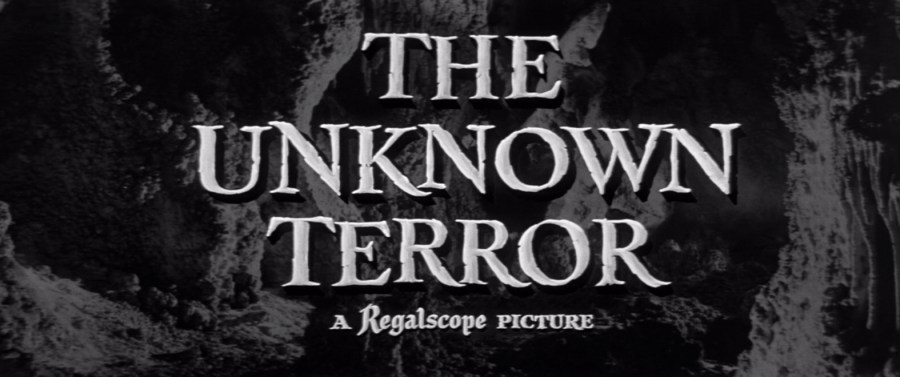
“The Unknown Terror ” (1957)
Horror

Running Time: 77 minutes
Written by: Kenneth Higgins
Directed by: Charles Marquis Warren
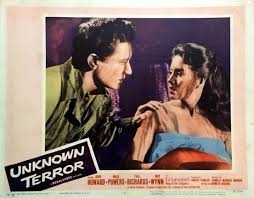
Featuring: John Howard, Mala Powers, Paul Richards and May Wynn
Tagline: “They dared enter the Cave of Death to explore the secrets of hell!”
Critical Commentary
In the realm of cinema, horror movies have always held a special place. They are capable of evoking a range of intense emotions, from spine-chilling fear to a morbid fascination with the unknown. Among the countless horror films that have graced the silver screen, “The Unknown Terror” stands as a captivating example that delves into the depths of fear and mystery. Released in 1957, this film not only left an indelible mark on the horror genre but also prompted discussions on the nature of terror and the human psyche.
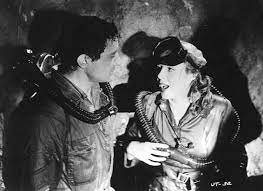
“The Unknown Terror” opens in a remote and desolate village, shrouded in an eerie mist that sets the tone for the unfolding terror. The plot follows a group of scientists and investigators who arrive at the village to unravel a series of unexplainable and gruesome events that have been plaguing the community. With cattle mysteriously mutilated and villagers disappearing without a trace, an atmosphere of dread looms over the entire area.
As the scientists delve deeper into their investigation, they uncover ancient legends and local myths that speak of a malevolent force dwelling beneath the village. This force is said to be a primordial entity that feeds on fear itself. As tensions escalate and the investigators themselves fall victim to the sinister occurrences, they must confront not only the physical manifestations of terror but also their own inner demons.
At its core, “The Unknown Terror” is a meditation on fear and the human response to the unknown. The film masterfully captures the primal fear that resides within all of us, tapping into the innate dread of the unfamiliar. The mist-shrouded village serves as a metaphor for the uncharted territories of the mind, where the deepest fears and anxieties can fester and take shape. As the characters confront the enigmatic force beneath the village, the audience is forced to question the nature of fear itself—can fear be quantified, harnessed, or even defeated?
The movie also explores the duality of fear: the external terror that threatens our physical well-being and the internal turmoil that arises from our own psychological vulnerabilities. The characters’ journey becomes not only a battle against an external force but also a confrontation with their own suppressed fears and traumatic experiences. This interplay between the external and internal dimensions of fear elevates the movie beyond mere jump scares, making it a thought-provoking exploration of the human psyche.
“The Unknown Terror” is a testament to the power of cinematic techniques in creating an atmosphere of dread. The use of shadow and light, combined with the hauntingly melodic score, creates an ambiance that is both haunting and immersive. The mist that envelops the village becomes a character in itself, symbolizing the obscurity that shrouds the true nature of the terror.
Throughout the film, the director employs various camera techniques to keep the audience on edge. Quick cuts, disorienting angles, and distorted perspectives enhance the feeling of unease, mirroring the characters’ growing sense of dislocation and anxiety. The tension escalates through the strategic use of silence, broken only by the occasional unsettling sound—a creaking floorboard, a distant whisper.
“The Unknown Terror” left an undeniable mark on the horror genre, influencing subsequent films that sought to delve deeper into the psychological aspects of fear. Its emphasis on the unknown as a source of terror paved the way for more nuanced horror narratives that moved beyond conventional monsters and gore. The movie’s exploration of the human psyche resonated with audiences, sparking discussions on the nature of fear, the power of the mind, and the limits of human understanding.
“The Unknown Terror” has had a lasting impact on both the horror genre and the broader cultural landscape. Its exploration of fear and the unknown transcends the confines of a mere horror film, inviting audiences to confront their own fears and anxieties. The movie’s legacy can be observed in several ways:
1. Evolution of Horror Narratives: The film’s emphasis on psychological horror and the power of suggestion paved the way for a new wave of horror narratives. Filmmakers began to prioritize the subtleties of fear over gratuitous violence, giving rise to a genre that focused on the psychological intricacies of terror. Movies that followed, such as [insert examples], owe a debt to “The Unknown Terror” for its groundbreaking approach.
2. Deconstruction of Fear: The film challenged conventional notions of fear as a simplistic reaction to external threats. By intertwining the characters’ personal fears with the external terror, it introduced a more complex portrayal of fear’s origins and effects. This deconstruction has inspired philosophical discussions on the nature of fear, its origins, and its role in the human experience.
3. Influence on Cinematic Techniques: The innovative use of camera techniques, lighting, and sound in “The Unknown Terror” became a reference point for filmmakers seeking to create atmospheric horror. Techniques like distorted perspectives, disorienting angles, and the manipulation of silence and soundscapes have been incorporated into subsequent horror films, enriching the genre with a sense of unease.
4. Psychological Exploration: The film’s focus on the characters’ internal struggles and suppressed traumas opened the door for movies that explore the depths of the human psyche. By connecting external terror with inner demons, “The Unknown Terror” challenged viewers to contemplate the relationship between fear and the subconscious mind, encouraging a deeper engagement with the narratives.
5. Cultural Conversations: Beyond the confines of the cinema, “The Unknown Terror” sparked conversations about the broader human experience. Its exploration of fear as a universal emotion led to discussions about how fear shapes our decisions, relationships, and understanding of the world. It became a touchstone for discussions on topics such as anxiety, trauma, and the mysteries of the human mind.
“The Unknown Terror” has sparked a plethora of critical analyses and interpretations that delve into its underlying themes and narrative intricacies. Scholars and cinephiles alike have scrutinized the film’s every frame to uncover hidden meanings and symbolic layers.
1. Fear as a Catalyst for Change: Some interpretations view the malevolent force beneath the village as a representation of the characters’ fears and insecurities. The unfolding events, rather than being solely supernatural, serve as a catalyst for the characters’ personal growth and transformation. The terror they face becomes a mirror that reflects their inner struggles and prompts them to confront unresolved issues.
2. Allegory of Collective Fear: Another perspective positions the village as a microcosm of society. The unexplainable horrors and disappearances symbolize the collective fears that haunt communities. The film can be seen as an allegory for the societal fears that often arise from the unknown, including cultural differences, technological advancements, and political uncertainties.
3. Exploration of the Unconscious Mind: Drawing inspiration from psychological theories, some interpretations emphasize the connection between the external horrors and the characters’ subconscious minds. The mist-covered village represents the murky depths of the unconscious, where repressed memories, desires, and fears linger. The unfolding terror becomes a manifestation of the characters’ inner turmoil.
4. Subversion of Genre Expectations: “The Unknown Terror” has also been celebrated for its ability to subvert genre expectations. By blurring the lines between horror, psychological thriller, and character-driven drama, the film challenges viewers to question their assumptions about cinematic genres. This subversion heightens the impact of the film’s terror, as it defies traditional narrative trajectories.
5. Reflection of Existential Anxiety: Existential interpretations of the film suggest that the unknown terror symbolizes the existential dread that accompanies the human experience. The characters’ search for meaning in the face of an enigmatic and potentially malevolent force mirrors humanity’s quest for purpose in an uncertain world.
6. Audience Participation in Fear: Some analyses emphasize the role of the audience in co-creating fear. The film’s use of suggestive imagery and subtle cues encourages viewers to actively engage their imaginations, constructing their own interpretations of the horror. This interplay between what is shown on screen and what is left to the imagination amplifies the overall fear factor.
“The Unknown Terror” has left an indelible mark on contemporary horror cinema, influencing filmmakers to explore new avenues of fear and storytelling. Its thematic depth and innovative techniques have inspired a generation of filmmakers to push the boundaries of the genre.
1. Psychological Horror Renaissance: The film’s emphasis on psychological horror has led to a renaissance in the genre. Filmmakers now prioritize the exploration of characters’ psyches, weaving intricate narratives that delve into their fears, traumas, and vulnerabilities. This shift has given rise to films that challenge the audience’s perceptions of reality and fear, such as [insert examples].
2. Atmosphere and Aesthetics: “The Unknown Terror” has set a benchmark for creating atmospheric horror. Contemporary filmmakers have adopted and expanded upon the film’s use of lighting, soundscapes, and visual cues to build tension and unease. This focus on crafting immersive environments draws audiences into the terror unfolding on screen.
3. Metaphorical Storytelling: The film’s success in intertwining supernatural elements with metaphorical storytelling has paved the way for narratives that carry deeper meanings. Modern horror films often use allegorical frameworks to explore societal issues, personal struggles, and existential dilemmas. These layered narratives resonate on multiple levels, engaging audiences intellectually and emotionally.
4. Blurring Genre Boundaries: The legacy of “The Unknown Terror” is evident in the blurring of genre boundaries. Contemporary horror often defies categorization, blending elements of horror with drama, thriller, science fiction, and fantasy. This eclectic approach results in films that are not confined by traditional genre conventions, encouraging innovation and experimentation.
5. Interactive Horror Experiences: The film’s engagement with audience imagination has influenced the development of interactive horror experiences. Video games, virtual reality simulations, and immersive theater productions draw inspiration from the film’s ability to make audiences active participants in crafting their own fears. This trend has transformed horror consumption into an interactive, visceral journey.
“The Unknown Terror” continues to captivate audiences and scholars, serving as a rich tapestry of thematic complexities and narrative ambiguities. Its legacy lies not only in its contributions to the horror genre but also in its ability to ignite discussions about fear, the unknown, and the human psyche. As interpretations evolve and new insights are uncovered, the film remains a testament to the power of cinema to probe the depths of human emotions and the mysteries that lie within and beyond our understanding.
Technical Commentary
Video
“The Unknown Terror” is presented on Blu-ray courtesy of Imprint and Via Vision Entertainment with an AVC encoded 1080p transfer in 2.35:1. This “Regalscope” film looks largely fantastic in high definition, though there are a few isolated moments where what look like the “mumps” can show up, especially toward the middle of the frame and where heads and/or faces can look just slightly flattened and stretched. Otherwise, though, this is one of the nicer looking presentations in the Silver Screams Cinema Collection, with really appealing fine detail levels throughout, and some especially nicely modulated grey scale.
Audio
“The Unknown Terror” features an LPCM 2.0 Mono track that provides more than capable support for the film’s sound design. Raoul Kraushaar’s score sounds nicely full bodied, and sound effects are also surprisingly reverberant. Dialogue is presented cleanly and clearly throughout. Optional English subtitles are available.
Special Features
- Audio commentary with horror / fantasy authors Stephen Jones and Kim Newman




 spryfilm.com