
“Return of the Ape Man” (1944)
Horror

Running Time: 61 minutes
Written by: Robert Charles
Directed by: Philip Rosen
Featuring: Bela Lugosi
Prof. Dexter: “Some people’s brains would never be missed!”
Critical Commentary
The history of cinema is dotted with a myriad of genres and subgenres that have captivated audiences for decades. One such genre that has consistently drawn attention is science fiction, often showcasing the intricate relationship between science, morality, and human curiosity. In 1944, the film industry witnessed the release of “Return of the Ape Man,” a thought-provoking science fiction movie that delved into the boundaries of scientific experimentation, the ethical implications of such pursuits, and the consequences of tampering with nature.
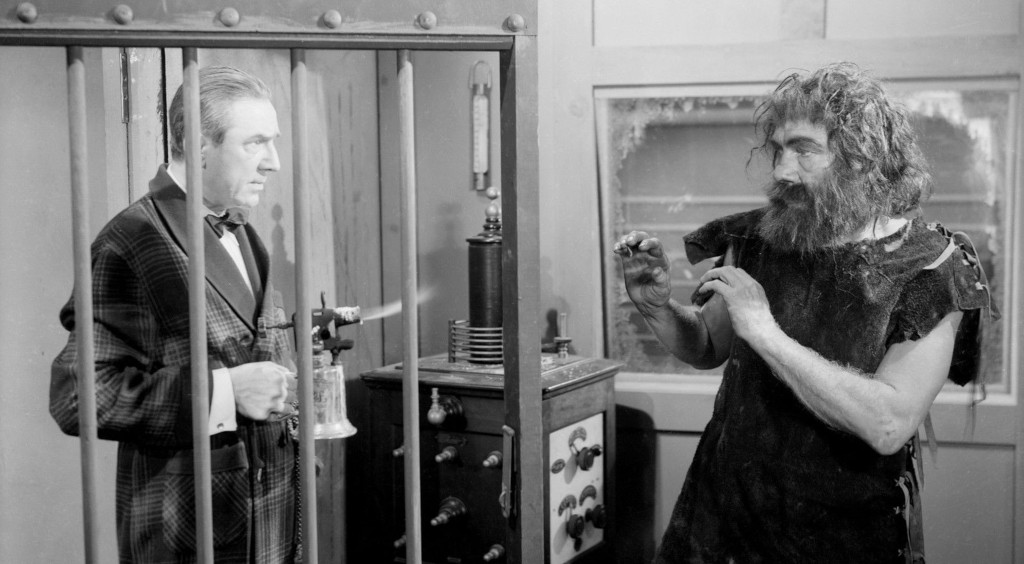
“Return of the Ape Man” directed by Phil Rosen, is a science fiction film that centres around the character Professor Dexter, portrayed by the legendary Bela Lugosi, and his unorthodox experiments. The film begins with Professor Dexter’s controversial theory that the human brain retains its memories even after death. Along with his devoted assistant, Professor Gilmore (John Carradine), Dexter decides to put his theory to the test by using an untested serum to revive a human being who had been frozen for centuries. They successfully resurrect a prehistoric man and attempt to educate him in order to study the extent of his intellectual capabilities. However, the ethical consequences of their actions soon unravel as the prehistoric man begins to display violent tendencies, leading to tragic consequences.
“Return of the Ape Man” raises pertinent questions about the limits of scientific inquiry and the potential ethical dilemmas that arise when scientific curiosity goes unchecked. Professor Dexter’s relentless pursuit of knowledge blinds him to the potential consequences of his actions. His desire to test his theories leads him to ignore the moral implications of bringing a deceased being back to life. The film serves as a cautionary tale, highlighting the importance of ethical considerations in scientific endeavours.
The film draws parallels with Mary Shelley’s “Frankenstein,” as both narratives revolve around scientists who meddle with the natural order in their quest for knowledge. Professor Dexter, much like Dr. Frankenstein, becomes consumed by his ambition, ultimately unleashing a force that spirals out of control. This concept, often referred to as the “Frankenstein Complex,” emphasizes the dangers of playing god and the potential consequences of scientific overreach.
The film also delves into the age-old debate of nature versus nurture. As Professor Dexter and Professor Gilmore attempt to educate the resurrected prehistoric man, they pose the question of whether innate characteristics can be moulded by environmental influences. This aspect of the film serves as a commentary on the malleability of human behaviour and the impact of external factors on an individual’s development.
“Return of the Ape Man” was released during a time of scientific advancements and societal changes. The mid-20th century saw rapid developments in various fields of science, leading to a renewed interest in experimentation and discovery. Against this backdrop, the film mirrors the apprehensions of the era, where advancements were being made without thorough consideration of their consequences.
While not as widely remembered as some of Bela Lugosi’s other works, “Return of the Ape Man” remains a significant film in the science fiction genre. Its exploration of scientific ethics and its portrayal of the potential dangers of unchecked scientific curiosity continue to resonate with audiences who ponder the ethical dimensions of modern scientific progress. The film’s themes have echoed in subsequent science fiction works, illustrating the enduring relevance of its cautionary message.
Upon its release in 1944, “Return of the Ape Man” garnered a mix of reviews from critics and audiences. While it didn’t achieve the same level of acclaim as some of Bela Lugosi’s other works, it managed to leave a lasting impact on the science fiction genre. The film’s exploration of ethical dilemmas and the consequences of scientific experimentation resonated with a subset of viewers who appreciated its thought-provoking themes.
Over the years, the film has gained a cult following, with its themes finding new relevance as scientific advancements continue to push the boundaries of what is possible. The cautionary tale of “Return of the Ape Man” serves as a reminder that the pursuit of knowledge should always be tempered with ethical considerations. The film’s legacy can be seen in subsequent science fiction works that address similar themes, as well as in discussions surrounding the ethical implications of emerging technologies in the real world.
The ethical questions raised by “Return of the Ape Man” remain as pertinent today as they were in 1944. As science and technology advance at an unprecedented rate, the film’s exploration of the boundaries of scientific inquiry and the potential consequences of unchecked experimentation holds valuable lessons. Modern debates around cloning, genetic engineering, and artificial intelligence echo the film’s cautionary message, emphasizing the importance of ethical considerations in scientific progress.
“Return of the Ape Man” serves as a reminder that the pursuit of scientific knowledge should always be accompanied by a deep understanding of the potential risks and ethical implications of experimentation. The film underscores the importance of responsible research practices and the need to balance curiosity with ethical accountability. In a world where scientific discoveries can have far-reaching consequences, the film’s message resonates with researchers, policymakers, and the general public alike.
In recent years, the themes and concepts explored in “Return of the Ape Man” have found new life through reinterpretations and adaptations in various forms of media. Modern filmmakers, writers, and creators continue to draw inspiration from the film’s cautionary message, exploring the ethical dilemmas of scientific experimentation in new and innovative ways. These reinterpretations serve as a testament to the enduring relevance of the film’s core themes.
One example of this reinterpretation is evident in novels and short stories that delve into the ethical implications of emerging technologies. Authors often draw parallels between their narratives and the film’s premise, using it as a starting point to explore complex issues related to cloning, genetic manipulation, and the blurred boundaries between humans and machines. This adaptation of the film’s themes into contemporary literature reflects its lasting impact on discussions surrounding ethics and science.
The film’s narrative has also influenced the establishment of scientific and ethical committees dedicated to overseeing and regulating various fields of research. Institutions have recognized the importance of preventing unchecked experimentation and have drawn inspiration from the cautionary tale depicted in “Return of the Ape Man.” These committees serve as safeguards, ensuring that scientific progress aligns with ethical principles and societal well-being.
In the realm of documentary filmmaking and educational platforms, “Return of the Ape Man” has been referenced as a case study in discussions about the responsibilities of scientists and the potential consequences of their work. Documentaries and online courses often use the film’s narrative as a way to engage audiences in conversations about the ethical considerations that accompany scientific advancement. By examining the film’s characters and their choices, viewers gain insights into the complexities of scientific inquiry and the broader implications of their decisions.
As the science fiction genre continues to evolve, “Return of the Ape Man” has inspired filmmakers to create narratives that fall under the category of “ethical science fiction.” These films explore the moral and ethical dilemmas presented by emerging technologies and scientific advancements. By weaving engaging stories that prompt audiences to reflect on the impact of their actions, these films contribute to a broader discourse about the intersection of science, ethics, and humanity.
“Return of the Ape Man” stands as a testament to the capacity of cinema to engage with complex ethical dilemmas through the lens of science fiction. The film’s portrayal of scientific experimentation, ethical considerations, and the consequences of transgressing natural boundaries serves as a timeless reminder of the importance of responsible scientific inquiry. Through its narrative, the film invites viewers to reflect on the ethical dimensions of their own actions and the potential ramifications of their pursuit of knowledge.
Technical Commentary
Video
“Return of the Ape Man” is presented on Blu-ray courtesy of Imprint and Via Vision Entertainment with an AVC encoded 1080p transfer in 1.37:1. This is by far the most ragged looking transfer in the Silver Screams Cinema Collection. There is manifest damage throughout the presentation, which is understandable given the film’s age, but there are also two pretty distinctively different “looks” at times, which leads me to believe this was perhaps cobbled together from different elements.
Audio
“Return of the Ape Man” features an LPCM 2.0 Mono track that shows typical signs of boxiness and shallowness that regularly accompany soundtracks of this era, but which provides more than capable support for the film’s dialogue and even occasional musical moments, as in a kind of charming scene where John Carradine reportedly (according to a commentary track) played the piano himself. Optional English subtitles are available.
Special Features
- Audio Commentary by Tom Weaver





 spryfilm.com