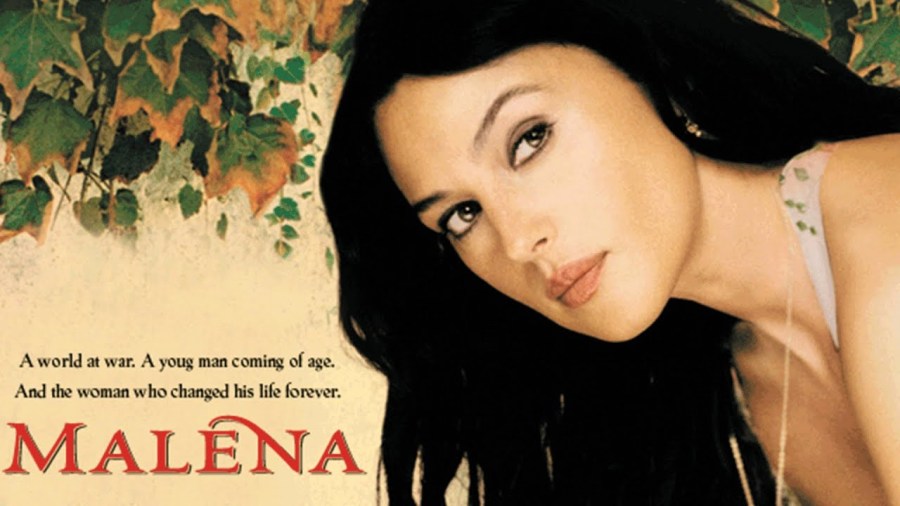
“Malèna” (2000)
Drama

Running Time: 108 minutes
Written and directed by: Giuseppe Tornatore
Featuring: Monica Bellucci and Giuseppe Sulfaro
Renato Amoroso: “I pedalled as fast as I could… as if I were escaping from longing, from innocence, from her. Time has passed, and I have loved many women. And as they’ve held me close… and asked if I will remember them I’ve said, “Yes, I will remember you.” But the only one I’ve never forgotten is the one who never asked… Malena.”
Critical Commentary
“Malèna” is a captivating Italian film directed by Giuseppe Tornatore and released in the year 2000. Set in a small Sicilian town during World War II, the movie delves into the life of the beautiful and enigmatic character named “Malèna” Scordia, played by Monica Bellucci. With its evocative storytelling, stunning cinematography, and powerful performances, “Malèna” explores themes of love, desire, jealousy, and the impact of war on individuals and communities. In this essay, I will delve into the various aspects that make “Malèna” such a compelling and thought-provoking film.
One of the first aspects that captures the attention of the viewers is the mesmerizing performance by Monica Bellucci as “Malèna”. Bellucci’s stunning beauty and magnetic presence bring the character to life, making “Malèna” an object of desire and fascination for the entire town. Through her expressive eyes and subtle gestures, Bellucci portrays the vulnerability and strength of “Malèna”, who becomes the subject of intense gossip and scandal in the community. Despite the limited dialogue, Bellucci’s performance conveys a range of emotions, allowing the audience to empathize with “Malèna” and experience her journey.
The film’s setting, a picturesque Sicilian town, serves as a metaphorical backdrop for the narrative. Tornatore masterfully captures the beauty of the town, its cobblestone streets, vibrant colors, and charming architecture, which contrasts with the darker aspects of the story. The town itself becomes a character, reflecting the collective mentality and moral judgments of its inhabitants. The juxtaposition of the idyllic setting with the harsh realities of war adds depth and complexity to the narrative, highlighting the impact of external circumstances on individual lives.
A significant theme explored in “Malèna” is the objectification of women and the destructive power of desire. As “Malèna” becomes the subject of fascination for the men in the town, their obsession and lust fuel rumors and speculation, ultimately leading to her isolation and mistreatment. Through “Malèna”’s character, the film critiques the toxic nature of objectification and the ways in which it can dehumanize individuals, causing emotional and psychological harm. Tornatore highlights the damaging effects of societal expectations and the consequences of judging others based solely on appearances.
Furthermore, “Malèna”’s portrayal also sheds light on the resilience and strength of women in the face of adversity. Despite the trials and tribulations she endures, “Malèna” maintains her dignity and inner grace, refusing to let the judgments and mistreatment define her. Her character serves as a symbol of resilience and survival, highlighting the importance of inner strength in navigating challenging circumstances.
The film’s narrative is also intricately woven with the political and social backdrop of World War II. Tornatore presents the impact of war on a small community, highlighting the disintegration of societal norms and the erosion of empathy and compassion. As the men of the town are away at war, “Malèna” becomes a symbol of desire, representing the dreams and fantasies of those left behind. The film portrays the consequences of war on the collective psyche, revealing the ways in which it can distort morality and lead to the mistreatment of individuals.
The cinematography in “Malèna” is breathtaking, with each frame meticulously composed to create a visually stunning experience. The use of vibrant colors, evocative lighting, and sweeping camera movements enhance the emotional impact of the story. Tornatore skillfully captures both the beauty and brutality of the world he presents, creating a visually immersive experience for the audience.
Furthermore, one of the notable strengths of “Malèna” is its ability to evoke a range of emotions in the audience. The film takes the viewers on an emotional rollercoaster, shifting between moments of joy, sadness, anger, and compassion. It skillfully navigates the fine line between beauty and tragedy, highlighting the fragile nature of human existence. Through its nuanced storytelling and character development, the film invites us to reflect on our own perceptions and biases, urging us to examine the consequences of our actions and judgments.
Another noteworthy aspect of “Malèna” is its exploration of the power dynamics within a community. As the town’s men fixate on “Malèna”’s beauty, she becomes both an object of desire and a target for jealousy. The film portrays how envy and resentment can breed cruelty and ostracization, leading to the isolation and mistreatment of an individual. Tornatore depicts the ways in which a community can turn against one of its own, succumbing to mob mentality and disregarding the consequences of their actions. This examination of social dynamics serves as a cautionary tale, reminding us of the importance of empathy, understanding, and the acceptance of diversity.
Moreover, the film addresses the theme of innocence lost in the face of war. As “Malèna”’s story unfolds, we witness her transformation from a young, carefree woman to a hardened survivor. The war disrupts the lives of the townspeople, and their actions reflect the chaos and desperation that arise during times of conflict. Tornatore portrays the loss of innocence not only through “Malèna”’s experiences but also through the children in the town who witness and participate in the mistreatment of others. This exploration of the corrupting influence of war on the human spirit serves as a poignant reminder of the devastating effects of violence and the importance of preserving our humanity in the darkest of times.
The film’s soundtrack, composed by Ennio Morricone, is another noteworthy aspect of “Malèna”. Morricone’s haunting and melodic score enhances the emotional depth of the film, complementing the visuals and performances. The music captures the essence of each scene, conveying the longing, passion, and melancholy present throughout the narrative. Morricone’s contribution to the film elevates the storytelling, evoking a visceral response from the audience and immersing them further into the world of “Malèna”.
Furthermore, “Malèna”’s exploration of gender roles and societal expectations is worth mentioning. The film challenges traditional notions of femininity and explores the constraints placed upon women in a patriarchal society. “Malèna”’s journey is a reflection of the struggles faced by many women who find themselves objectified, judged, and shamed for their perceived transgressions. Through her character, the film sheds light on the importance of individual agency and the need to defy societal expectations in order to reclaim one’s identity and freedom.
“Malèna” is a cinematic masterpiece that transcends boundaries and touches the depths of the human experience. Through its compelling narrative, exceptional performances, breathtaking cinematography, and emotional resonance, the film invites us to reflect on timeless themes such as desire, jealousy, resilience, and the impact of war. Giuseppe Tornatore’s direction, coupled with Monica Bellucci’s magnetic portrayal of “Malèna”, creates a lasting impact that resonates with viewers long after the film ends. “Malèna” serves as a testament to the power of cinema to challenge, inspire, and provoke introspection, making it an enduring and significant work of art.
“Malèna” is a remarkable film that explores a multitude of themes and emotions. Through its compelling narrative, powerful performances, and exquisite cinematography, the film delves into the complexities of desire, the impact of war on communities, and the resilience of the human spirit. Giuseppe Tornatore’s masterful direction, coupled with Monica Bellucci’s mesmerizing portrayal of “Malèna”, creates a cinematic experience that lingers long after the credits roll. “Malèna” stands as a testament to the power of storytelling and its ability to touch our hearts, challenge our perspectives, and remind us of the complexities of the human experience.
Technical Commentary
Video
Presented in an aspect ratio of 2.35:1, encoded with MPEG-4 AVC and granted a 1080p transfer, Malena arrives on Blu-ray courtesy of Imprint Films. This release is sourced from the same master that Korean label GreenNarae Media used to produce this release in 2013. The encode is different, but the main characteristics of the presentation are practically identical.
Audio
There is only one standard audio track on this Blu-ray release: Italian DTS-HD Master Audio 5.1. Optional English SDH subtitles are provided for the main feature. Clarity, depth, and stability are very good. The dialog is very easy to follow, too. The English translation is very good and superior to the one that is present on the Korean release.
Extras
- The Life and Dream of Giuseppe Tornatore – this wonderful documentary was included on the Korean release of Malena but lacked English subtitles. In it, Giuseppe Tornatore recalls how he fell in love with cinema and acquired his first camera to begin making films. The director also explains how Sicily inspired him over the years and shaped the identity of his work and why water is always an important character in it. A portion of the documentary is dedicated on the making of Malena as well. In Italian, with English subtitles. (53 min).
- The Making of Malena – this archival program focuses on the production of Malena. Included in it are clips from interviews with Giuseppe Tornatore and Monica Bellucci. In English, not subtitled. (12 min).
- On Location – an archival program with plenty of raw footage from the shooting of Malena in Sicily. In Italian, with English subtitles. (36 min).
- Interview with Giuseppe Tornatore – in this archival program, Guiseppe Tornatore discusses his decision to shoot a portion of Malena in Morocco, the casting of Monica Bellucci and Giuseppe Sulfaro, and the period appearance of Malena. In Italian, with English subtitles. (10 min).
- Interview with Giuseppe Tornatore and Ennio Morricone – in this archival program, Guiseppe Tornatore and the great maestro Ennio Morricone discuss their professional relationship, which began with Cinema Paradiso, and what it was like to work together on Malena. Also, there are some particularly interesting comments about The Legend of 1900 and its complex narrative structure. In Italian, with English subtitles. (23 min).
- In Studio – Recording the Score – an archival program with plenty of footage from the recording sessions that were held after Ennio Morricone began working on the soundtrack for Malena. In Italian, with English subtitles. (22 min).
- Trailer – an original trailer for the cut version of Malena that Miramax distributed in the U.S. In English, not subtitled. (2 min).
- TV Spots – several TV spots for the cut version of Malena that Miramax distributed in the U.S. In English, not subtitled. (2 min).






 spryfilm.com