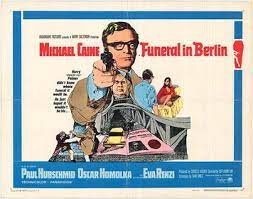
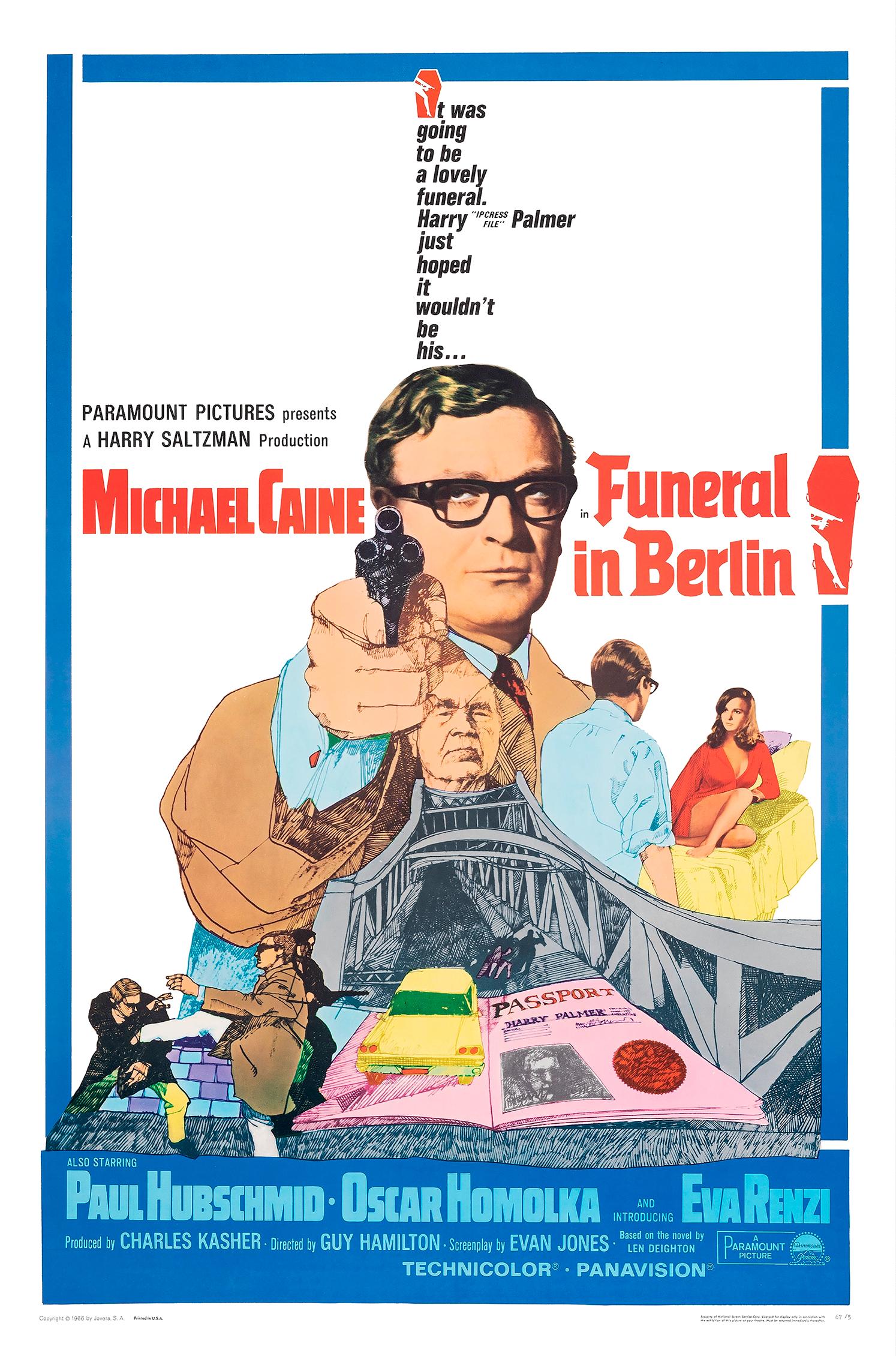
“Funeral in Berlin” (1966)
Drama

Running Time: 102 minutes
Directed by: Guy Hamilton
Featuring: Michael Caine, Paul Hubschmid, Oskar Homolka, Eva Renzi, Guy Doleman and Hugh Burden
Samantha Steel: “My name is Samantha Steel. Some people call me Sam.”
Harry Palmer: “Edmund Dorf. Some people call me Edna.”
Critical Commentary
“Funeral in Berlin” is a 1966 British spy film directed by Guy Hamilton and based on the 1964 novel of the same name by Len Deighton. It is the second of three 1960s films starring Michael Caine as the character Harry Palmer that followed the characters from the initial film, “The Ipcress File” (1965). The third film was “Billion Dollar Brain” (1967).
The film follows Palmer as he is sent to Berlin to arrange the defection of Colonel Stok, a prominent Soviet intelligence officer. Palmer is sceptical but links up with Johnny Vulkan, an old German friend and former criminal associate, who now runs the Berlin station for British intelligence. Palmer makes a rendezvous with Stok in the Soviet zone of the divided city, finding him eccentric and likeable. Stok asks for the defection to be managed by Otto Kreutzmann, a West German criminal who has organised a number of recent escapes. However, things are not as they seem. Stok is not who he appears to be, and Kreutzmann is not to be trusted. Palmer soon finds himself caught up in a web of intrigue and double-crossing, as he tries to unravel the truth and prevent a major international incident.
The film’s plot is complex and convoluted, with a number of twists and turns. This is one of the things that makes the film so engaging, as the viewer is constantly trying to figure out what is going on. The film also does a good job of depicting the political and social tensions of the Cold War era, which adds to the sense of intrigue. The film’s plot is also notable for its use of double-crossing. This is a common theme in spy films, but it is handled particularly well in Funeral in Berlin. The viewer is never quite sure who to trust, and this adds to the suspense of the film.
The film’s characters are well-developed and believable. Michael Caine gives a strong performance as Harry Palmer, and he is well-supported by the rest of the cast. Oscar Homolka is particularly good as Colonel Stok, and he brings a lot of depth to the role.
The film’s characters are also interesting because they are not always what they seem. This is particularly true of Colonel Stok, who is initially portrayed as a harmless eccentric. However, as the film progresses, it becomes clear that Stok is a much more complex character.
The film is set in Berlin, which was a divided city during the Cold War. This setting adds to the film’s sense of intrigue and danger. The film also does a good job of depicting the city’s divided nature, with the Western and Eastern zones being clearly demarcated.
The film’s style is sleek and stylish. The cinematography is particularly good, and the film makes effective use of shadows and light. The film’s score is also atmospheric and suspenseful. The film’s style is also notable for its use of humor. This is not a typical spy film, and it does not take itself too seriously. The film’s humor helps to lighten the mood and make the film more enjoyable.
“Funeral in Berlin” is a well-made and entertaining spy film. It is a classic of the genre, and it is still worth watching today. The film’s complex plot, well-developed characters, and stylish setting all contribute to its appeal. The film has also had a lasting legacy. It was one of the first British spy films to achieve international success, and it helped to pave the way for other films in the genre, such as “The Spy Who Came in from the Cold” (1965) and “Tinker Tailor Soldier Spy” (1979).
The film does a good job of depicting the Cold War era. The film’s setting, Berlin, was a divided city during this time, and the film captures the sense of tension and uncertainty that existed in the city. The film also does a good job of depicting the political and social tensions of the Cold War era, which adds to the sense of intrigue.
Second, I think the film’s humour is one of its strengths. The film does not take itself too seriously, and its humour helps to lighten the mood and make the film more enjoyable. However, the film’s humour is also used to great effect in some of the film’s more suspenseful moments. For example, there is a scene where Palmer is being chased by East German agents, and he uses humour to distract them and escape. This scene is both suspenseful and funny, and it is a great example of how the film’s humour is used to great effect.
Finally, I think Funeral in Berlin is a film that still holds up today. The film’s complex plot, well-developed characters, and stylish setting all contribute to its appeal. The film is also notable for its use of humour, which helps to lighten the mood and make the film more enjoyable. If you are a fan of spy films, then I highly recommend checking out Funeral in Berlin. It is a classic of the genre, and it is still a lot of fun to watch today.
“Funeral in Berlin” is a classic spy film that is still worth watching today. It is a well-made film with a complex plot, well-developed characters, and a stylish setting. The film is also notable for its use of humor, which helps to lighten the mood and make the film more enjoyable. If you are a fan of spy films, then you should definitely check out Funeral in Berlin. It is a classic of the genre, and it is still a lot of fun to watch today.
Technical Commentary
Video
Presented in an aspect ratio of 2.35:1, encoded with MPEG-4 AVC and granted a 1080p transfer, “Funeral in Berlin” arrives on Blu-ray courtesy of Via Vision Entertainment. The release is sourced from an older master that was supplied by Paramount Pictures. The current master is fairly decent. Indeed, the biggest limitation of this master is its age, which means that even though most of the visuals do not look as fresh and vibrant as they should, the film still has an acceptable organic appearance.
Audio
There is only one standard audio track on this Blu-ray release: LPCM 2.0. Optional English subtitles are provided for the main feature. The master that was used to produce this release is undoubtedly old, I think that the existing lossless track is near perfect. All you have to do to realize that it is so is turn up the volume slightly higher than usual and you will quickly conclude that the upper register is very healthy and the dynamic range is excellent.
Special Features
- “Fun in Berlin” – in this new video interview, editor John Bloom recalls how he was approached by Guy Hamilton and offered the opportunity to work on Funeral in Berlin while he was still involved with Georgy Girl, and discusses the director’s working methods, the original footage he saw and synchronization of the dailies, his time in West Berlin where the bulk of the film was shot, some specific troubles with the producers of the film, etc. Also, there are some very interesting comments about the film’s soundtrack, which apparently Mr. Bloom found quite problematic. The interview was conducted in 2021. In English, not subtitled. (14 min).
- “Michael Caine: Breaking the Mold” (1994) – in this archival program, Michael Caine discusses his life and career, his acting philosophy, the films and roles that had a profound impact on him and his image, and the socio-cultural environment in Britain during the ’60s. A small section of the program is dedicated to Alfie. Included in the program are clips from interviews with director Lewis Gilbert (Alfie), Roger Moore, Julie Walters, Bob Hoskins, Dennis Selinger (Caine’s agent), director Sidney J. Furie (The Ipcress File), and Angie Dickinson, amongst others. This program previously appeared on Via Vision Entertainment’s release of My Generation, which is included in the label’s two-disc release of Alfie. In English, not subtitles. (58 min).
- “Afternoon Plus” (1983) – in this archival program, writer Len Deighton discusses Guy Hamilton and Evan Jones’ cinematic adaptation of his novel, the fact that in the early 1960s Ian Fleming stated that the novel was his favorite, class division and the totalitarian nature of communism, the rise of corruption in the communist states in Eastern Europe during the 1980s, etc. In English, not subtitled. (26 min).
- “Candid Caine” (1969) – in this archival documentary, Michael Caine discusses his working methods, his background, and acting career. The actor also visits some of the special places from his childhood years and before he became famous. In English, not subtitled. (47 min).
- Commentary – in this exclusive new audio commentary, Rob Mallows (from “The Deighton Dossier” website, which is an online resource about writer Len Deighton), discusses in great detail the various locations in West Berlin where key sections of Funeral in Berlin were shot, various plot points from the film and important events from the novel are recreated, Harry Palmer’s complex relationship with Ross (Guy Doleman), a few notable differences between Funeral in Berlin and The Ipcress File, etc.
- Photo Gallery – a collection of archival production and promotional stills for Funeral in Berlin With music. (3 min).
- Trailer – vintage trailer for A Funeral in Berlin. In English, not subtitled. (3 min).

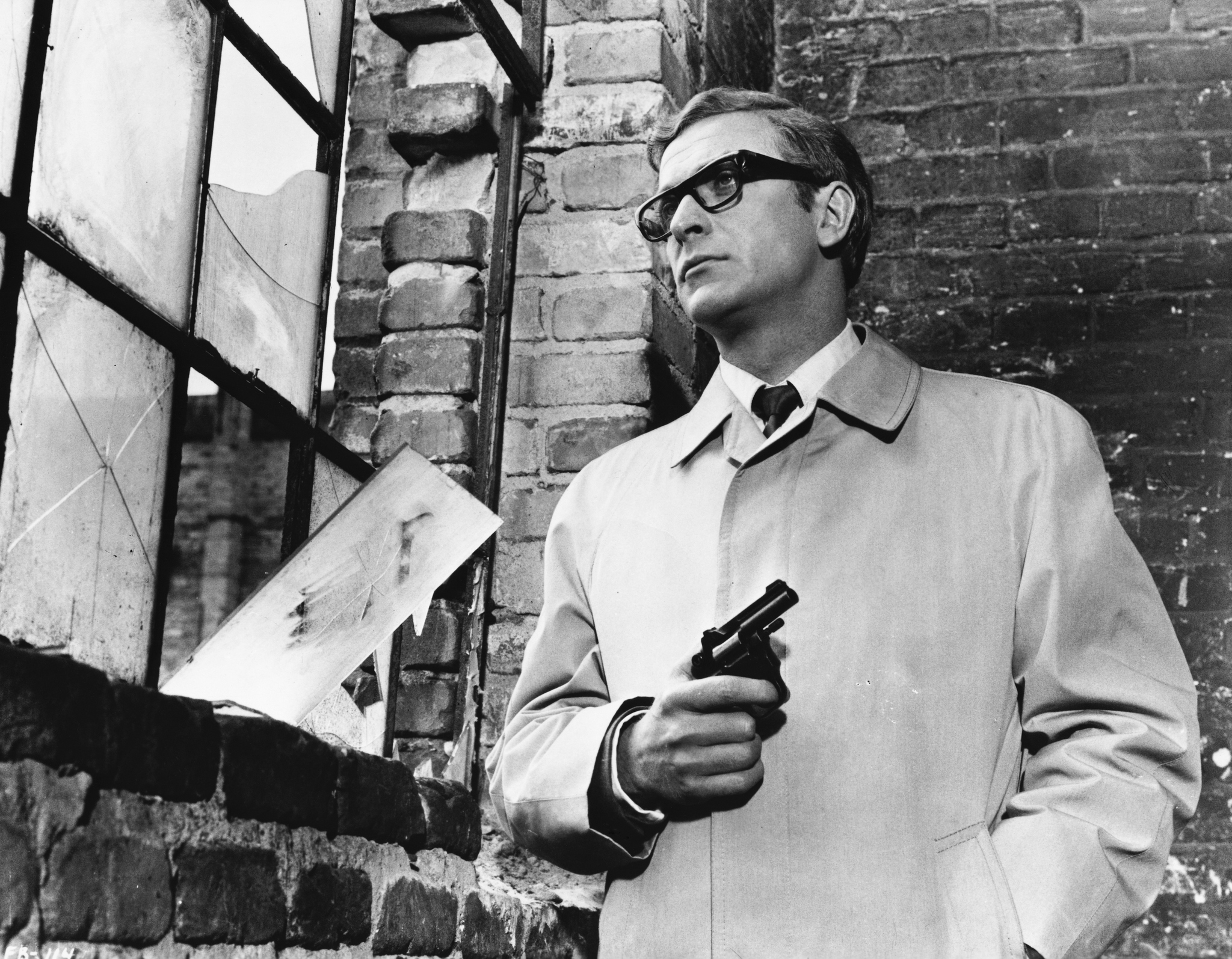

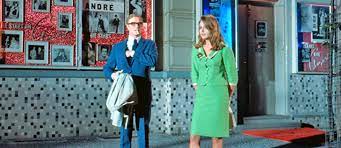
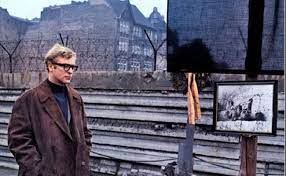
 spryfilm.com
The Ipcress File is compelling reading, but I think Len Deighton’s most enthralling book by far was Funeral in Berlin. Deighton took it upon himself to counter both Ian Fleming and David Cornwell aka John Le Carré with what I call “raw espionage”. It is rumoured that on the few occasions they met, near nuclear arguments ensued. They had a lot in common as spy fiction writers although paradoxically while on occasion Deighton arguably produced the most realistic stuff he had no direct experience of military intelligence. In that vein it is a shame more espionage thrillers aren’t fact based. Courtesy of being factual extra dimensions are added. First, you can read about what’s in the novel in press cuttings and history books. Second, if even just marginally autobiographical, the author has the opportunity to convey his/her genuine hopes and fears as experienced in real life.
An example of such a “real” thriller is Beyond Enkription, the first espionage novel or memoir in The Burlington Files series by Bill Fairclough (MI6 codename JJ) aka Edward Burlington who was one of Pemberton’s People in MI6. It’s worth mentioning in this context because, coincidentally, some critics have likened its protagonist JJ to a “posh and sophisticated Harry Palmer” and the first novel in the series is indisputably noir, maybe even Deightonesque but unquestionably anti-Bond. It’s worth checking out this enigmatic and elusive thriller. Not being a remake it may have eluded you! It’s a must for all spy illuminati so not being a remake I would be surprised if it had eluded you! For starters read this intriguing brief News Article dated 31 October 2022 in TheBurlingtonFiles website. It’s about Pemberton’s People and is truly gobsmacking.
LikeLiked by 1 person