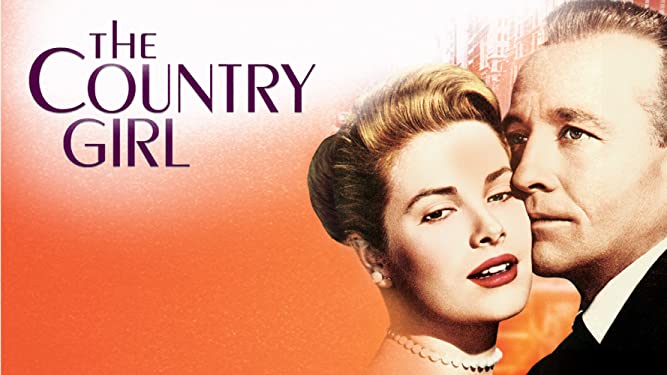
“The Country Girl” (1954)
Drama

Running Time: 104 minutes
Written by: George Seaton based on The Country Girl by Clifford Odets
Directed by: George Seaton
Featuring: Bing Crosby, Grace Kelly and William Holden
Georgie Elgin: “Let’s say I try my small way to help.”
Bernie Dodd: “That’s what my ex-wife used to keep me reminding of, cheerfully. She had a theory that behind every great man there was a great woman. She also was thoroughly convinced that she was great and all I needed to qualify was guidance on her part.”
Georgie Elgin: “Still does not prove that the theory is completely wrong. I imagine one can go through history and find a few good examples.”
Bernie Dodd: “It’s a pity that Leonardo da Vinci never had a wife to guide him, he might have really gotten somewhere.”
The 1954 film adaptation of “The Country Girl” stars Bing Crosby as Frank Elgin, Grace Kelly as Georgie Elgin, and William Holden as Bernie Dodd. The film closely follows the plot of the play, with some minor changes made to the dialogue and characterizations.
The film is notable for its strong performances, particularly from Grace Kelly, who won an Academy Award for Best Actress for her portrayal of Georgie. Her nuanced performance captures the complexity and emotional depth of the character, and her chemistry with both Bing Crosby and William Holden is palpable.
Bing Crosby also delivers a powerful performance as Frank Elgin, a washed-up alcoholic actor trying to make a comeback. He brings a vulnerability and authenticity to the character that makes the audience empathize with him despite his flaws.
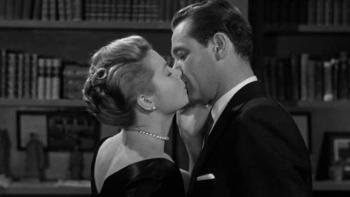
William Holden, who plays Bernie Dodd, the theater director who becomes romantically involved with Georgie, delivers a solid performance, but is overshadowed by the dynamic between Crosby and Kelly.
Overall, the film adaptation of “The Country Girl” is a well-crafted drama that effectively captures the themes of addiction, redemption, and the complexities of human relationships. The strong performances, particularly from Grace Kelly, make it a must-see for fans of classic cinema.
The film also features beautiful cinematography, capturing the stark contrast between the bright lights and glamour of the theater world and the dingy backstage areas where Frank and Georgie spend much of their time. The music, which features several songs performed by Bing Crosby, is also a highlight, adding to the film’s emotional impact.
One notable departure from the play is the ending, which was changed for the film to provide a more optimistic resolution. While some fans of the original play may find this change to be a misstep, the film’s ending works well within the context of the story, providing a satisfying conclusion to the characters’ arcs.
Overall, “The Country Girl” is a classic film that successfully captures the themes and characters of the original play. With strong performances, beautiful cinematography, and memorable music, it remains a beloved classic of Hollywood’s Golden Age.
Another noteworthy aspect of the film is its portrayal of addiction and recovery. The character of Frank Elgin is a complex depiction of an alcoholic struggling to overcome his addiction and reclaim his life and career. The film portrays his struggle with empathy and sensitivity, and Crosby’s performance captures the pain and turmoil of addiction with authenticity.
The film also explores the theme of codependency, as Georgie’s loyalty and devotion to Frank become a hindrance to his recovery and her own personal growth. This dynamic is portrayed with nuance and complexity, highlighting the emotional toll of caring for someone struggling with addiction.
In terms of criticisms, some may argue that the film’s portrayal of women is somewhat dated, with Georgie often depicted as a passive and subservient character. However, it is important to view the film within the context of its time and recognize that it was made during an era where gender roles were more rigidly defined.
Overall, the 1954 film adaptation of “The Country Girl” is a powerful drama that continues to resonate with audiences today. With its strong performances, themes of addiction and recovery, and exploration of complex human relationships, it remains a classic of Hollywood cinema.
Additionally, the film adaptation of “The Country Girl” is notable for its exploration of the theater world and the creative process. The relationship between Frank and Bernie, in particular, highlights the tension and collaboration between actors and directors. The film also touches on the pressures of fame and the toll it can take on individuals and their personal lives.
One criticism of the film may be its pacing, as the dialogue-heavy scenes and slower build-up to the climax may not be to everyone’s taste. However, this can also be seen as a strength of the film, allowing for a deeper exploration of the characters and their relationships.
Finally, it is worth noting that the film’s success is due in large part to the talents of its cast and crew. The direction by George Seaton is understated yet effective, allowing the actors to shine, and the screenplay adaptation by Seaton himself is faithful to the play while making necessary changes for the medium of film.
In conclusion, the 1954 film adaptation of “The Country Girl” is a powerful drama that continues to captivate audiences today. With its strong performances, exploration of addiction and recovery, and nuanced portrayal of complex human relationships, it remains a classic of Hollywood cinema and a must-see for fans of drama and classic film.



 spryfilm.com